





September brings the first signs of spring to South Africa, and it also gives us plenty of reasons to look up.
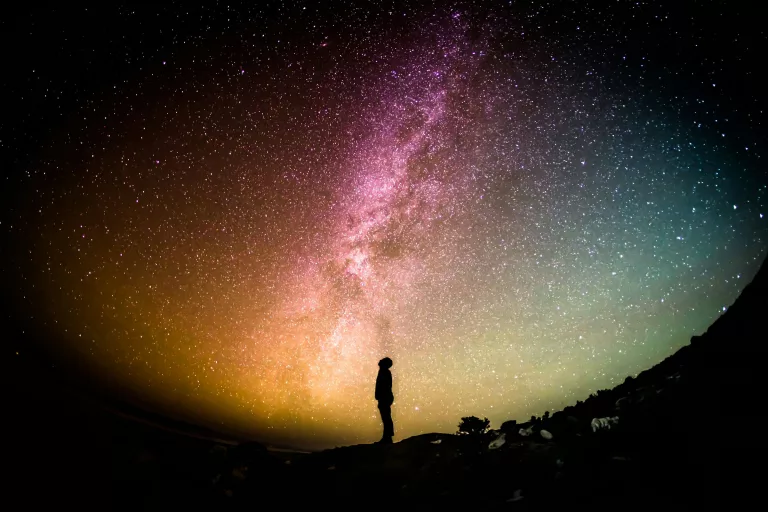
Photo: Unsplash
Here are the astronomical events worth putting on your September calendar.
9–10 September: The Epsilon Perseids meteor shower
September doesn’t have one of the year’s major meteor showers, but the Epsilon Perseids are worth keeping an eye out for.
The shower reaches its peak around 9–10 September, with up to roughly eight meteors per hour possible under ideal conditions. This is a relatively modest shower, so don’t expect August’s Perseids-style fireworks.
The timing is helpful, however, as the peak falls just before the New Moon, meaning moonlight won’t interfere too much with the darker sky.
Visible from South Africa: Yes, although the shower is not considered particularly strong from the Southern Hemisphere.
11 September: New Moon
This is one for anyone planning a proper stargazing escape. The September New Moon occurs at 05:27 in Cape Town on 11 September. At New Moon, the Moon is positioned between Earth and the Sun, meaning its illuminated side faces away from us and it is essentially invisible in the night sky. That is actually good news for stargazers.
The nights around 9–12 September should offer some of the darkest skies of the month, making this a particularly good time to get away from artificial light and look for fainter stars and deep-sky objects.
If you’re planning a camping trip purely for stargazing, this is one of the best windows to target.
Visible from South Africa: The New Moon itself isn’t visible, but the dark skies surrounding it are excellent for stargazing across South Africa.
14–20 September: Follow the Moon towards the Milky Way
This is arguably one of the best stretches of September for southern stargazers.
NASA recommends following the Moon as it moves past Antares and the Teapot-shaped group of stars in Sagittarius between 14 and 20 September. The Teapot points towards the centre of our Milky Way galaxy, which can appear as a hazy band under sufficiently dark skies.
This is where South Africa has a serious advantage. Get away from the lights of Cape Town, Johannesburg or Durban and the difference can be remarkable.
Look towards the southern and southwestern sky after sunset and give your eyes some time to adjust to the darkness.
Visible from South Africa: Yes, and particularly well suited to dark-sky locations in the country’s interior.
14 September: The Moon and Venus meet
On 14 September, the young crescent Moon will appear close to brilliant Venus, making one of the month’s easiest celestial photo opportunities.
Venus will be particularly bright and should stand out against the fading evening light.
The Moon will also make the planet easier to find: look towards the western sky shortly after sunset and use the crescent as your guide.
Visible from South Africa: Yes. The close pairing is visible, although the exact appearance and timing will vary depending on where in the country you are.
18 September: Venus reaches peak brilliance
If you only remember one planet this month, make it Venus. On 18 September, Venus reaches peak brilliance for its current evening appearance, shining at around magnitude -4.8. It will be unmistakably bright and should easily outshine the surrounding stars. NASA recommends looking towards the western horizon shortly after sunset.
And for South African observers, there’s another bonus: viewing conditions for this particularly bright Venus are favourable in the Southern Hemisphere.
Visible from South Africa: Yes. Look west shortly after sunset.
18 September: First Quarter Moon
The Moon reaches first quarter at 22:43 SAST on 18 September.
This is also a great phase for anyone interested in photographing the Moon or looking at it through binoculars or a telescope, as the angle of sunlight creates prominent shadows along the lunar surface.
Visible from South Africa: Yes.
19 September: International Observe the Moon Night
You don’t need a major astronomical event to make an evening of stargazing. International Observe the Moon Night takes place on 19 September, inviting people around the world to look at and learn about Earth’s nearest celestial neighbour. NASA says people can participate from wherever they are, including by simply observing the Moon from home.
If you have binoculars or a telescope, this is a good opportunity to get a closer look at the Moon’s craters and rugged surface.
22–23 September: The September equinox
Spring officially arrives in the Southern Hemisphere with the September equinox. The equinox marks the moment when the Sun crosses Earth’s equatorial plane. NASA gives the exact astronomical moment as 00:05 UTC on 23 September, which is 02:05 SAST in South Africa.
There isn’t a dramatic spectacle to watch for at the exact moment, but it marks the astronomical beginning of spring in the Southern Hemisphere. From here, the days continue getting longer as we head towards summer.
Visible from South Africa: The equinox itself isn’t something you can see happening, but it marks the changing season.
26 September: Full Moon and the Harvest Moon
September’s full Moon arrives on 26 September at 18:49 SAST. It is traditionally known as the Harvest Moon, referring to the full Moon closest to the September equinox. The name comes from the Northern Hemisphere and doesn’t mean the Moon will actually look different from an ordinary full Moon.
For South African observers, the real attraction is simply watching the full Moon rise over the eastern horizon around sunset.
26 September: The Moon, Saturn and Neptune
The full Moon will appear near Saturn and Neptune, creating a particularly interesting evening for anyone with binoculars or a telescope.
Saturn is the easy target: it is bright enough to see with the naked eye. Neptune is considerably more difficult. At around magnitude 8, it is too faint to see without optical equipment, but binoculars or a telescope can reveal it.
Neptune also reaches opposition around 26 September, putting it in a favourable position for observation. At opposition, a planet is opposite the Sun in Earth’s sky, meaning it is generally visible for much of the night.
Visible from South Africa: Saturn and the Moon are easily visible. Neptune is visible with binoculars or a telescope.
30 September: Another chance to see the Moon near the Pleiades
If you missed the Moon’s meeting with the Pleiades earlier in the month, there’s another opportunity at the end of September, when the Moon once again appears close to the star cluster.
The Moon will be in a very different phase by this point, so the view will look quite different from the early-September pairing.
Visible from South Africa: Yes, subject to local viewing conditions.
The best time for stargazing in September
If you’re planning a night under the stars, the days around the New Moon are your best bet for darker skies, particularly around 9–12 September.
For the Milky Way, head somewhere with as little artificial light as possible. South Africa’s Karoo, Northern Cape, Cederberg and other rural areas can offer excellent conditions when the weather cooperates.
You don’t need a telescope for most of September’s highlights either. A pair of binoculars, a camping chair and a clear view of the sky will get you surprisingly far.
ALSO SEE: Cape Town night tours: Explore the SAAO this September