


Across the country, coastal towns offer cliff-top walks, dramatic viewpoints, historic lighthouses, estuaries, wildlife and hiking trails that reveal a different side of the ocean. In some places, the best view is from a mountain above the sea; in others, it is from a winding coastal path or an estuary where freshwater meets the Indian Ocean.
These six towns are worth visiting when you want to experience the coast without making a conventional beach day the main event.
1. Hermanus, Western Cape
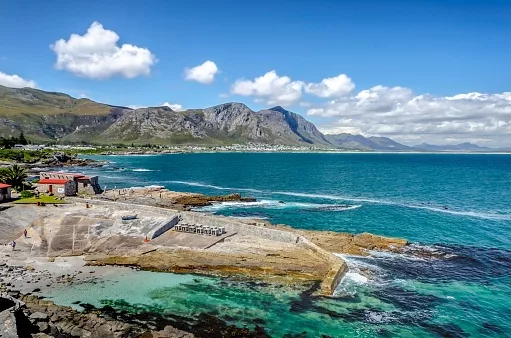
Panoramic view of Hermanus bay from Hermanus Whale Watching View Point/By: AlagnaMarco/Getty Images
Walk the cliffs while watching for whales
Hermanus is one of South Africa’s best-known destinations for experiencing marine life from land. The town’s Cliff Path stretches for more than 12km along Walker Bay, with benches and viewpoints positioned above the water.
The path runs from New Harbour towards Grotto Beach and offers plenty of opportunities to stop and look out across the bay. During whale season, southern right whales can be seen from the shoreline as they arrive to mate and calve. Bryde’s whales can be seen throughout the year, while humpback whales pass the coast between June and November.
The appeal isn’t limited to whales. The Cliff Path passes coastal vegetation, rocky shorelines and small coves, making the walk worthwhile even when the ocean is quiet.
Make a day of the coastline
Start near the Old Harbour and follow sections of the Cliff Path at your own pace. Gearing’s Point is another useful viewpoint over Walker Bay, while Sievers Point is particularly popular for whale watching.
If you visit outside whale season, the route still delivers sweeping ocean views and opportunities to see seabirds and marine life below the cliffs.
2. Knysna, Western Cape
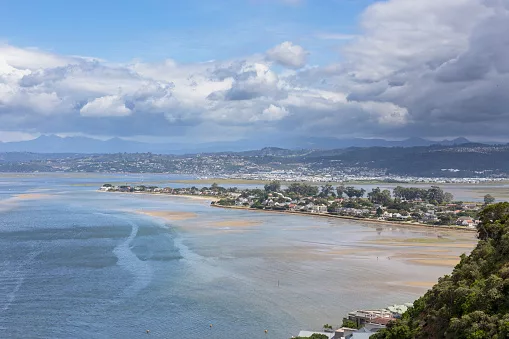
From viewpoint Eastern Knysna Head/By: Merten Snijders/Getty Images
Look out over the meeting point of lagoon and sea
Knysna is a coastal town where the ocean is best understood as part of a much bigger landscape.
The famous Knysna Heads are two sandstone headlands framing the entrance to the Knysna Estuary. From the Eastern Head viewpoint, visitors can look across the lagoon towards the mountains while also seeing the Indian Ocean beyond.
The viewpoint has several viewing decks, making it an easy place to stop and take in the scale of the landscape. At the bottom of the Eastern Head, Fountain Point offers another perspective beneath the cliffs, with a pathway running along the foot of the headland.
Follow the coastline on foot
For a more active experience, the Featherbed Nature Reserve on the Western Head includes a 2.2km coastal walk as part of its guided experience. The route provides views along the Garden Route coastline and across the Knysna Lagoon.
You can also drive towards Brenton-on-Sea and stop at the elevated viewpoint overlooking the Indian Ocean. During whale season, the viewpoint is used as a land-based whale-spotting location.
Knysna is therefore less about sitting beside a single stretch of beach and more about understanding how forest, lagoon, cliffs and ocean fit together.
3. Mossel Bay, Western Cape
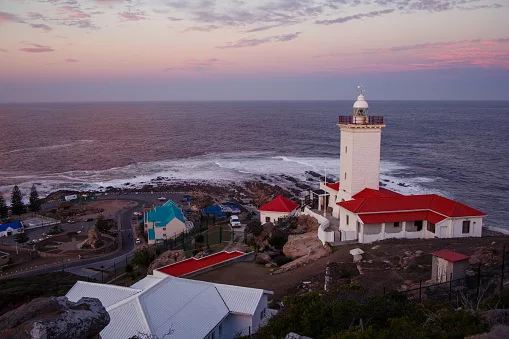
Cape Saint Blaize Lighthouse/By: Makayla McGarvey/iStock
Follow a cliff trail beneath a historic lighthouse
Mossel Bay has more than 60km of coastline, but one of the best ways to experience it is from above the water.
The Cape St Blaize Lighthouse stands on the cliffs at the Point, where the town gives way to a rugged stretch of coastline. The lighthouse has been operating since 1864, and its elevated position gives visitors expansive views across the bay and along the cliffs.
The setting also makes it possible to combine coastal scenery with history. St Blaize Cave lies below the lighthouse, while the St Blaize Trail begins nearby.
Take the St Blaize Trail
The 13.5km St Blaize Trail follows the cliffs westwards from the lighthouse towards Dana Bay. The route takes around six hours and is graded moderate, with the trail following the 30m contour above the coastline.
It is a good choice for travellers who want to turn a coastal viewpoint into a proper day outdoors. Expect cliffs, ocean views, fynbos and the occasional glimpse of marine life rather than a conventional beach itinerary.
If you are not up for the full hike, simply visiting the lighthouse and exploring the Point gives you the same sense of the landscape on a much shorter outing.
ALSO READ:
4. Cape St Francis, Eastern Cape
Climb a lighthouse for a different view of the coast
Cape St Francis is home to one of the Eastern Cape’s most distinctive coastal landmarks, the Seal Point Lighthouse.
Built in 1878, the lighthouse stands on a peninsula surrounded by ocean and remains operational today. At 27.75m, it is described by St Francis Tourism as the tallest masonry lighthouse in South Africa.
The lighthouse provides a particularly good reason to experience the ocean from land because the view changes as you climb.
Climb 154 steps to the lantern room
Guided tours allow visitors to climb the 154 steps to the lantern room, 28m above the ground, for broad views over the surrounding coastline and Cape St Francis. Tours are weather dependent.
The lighthouse also gives the destination a strong maritime character. Rather than simply looking towards the ocean from a beach, you can stand inside a working coastal landmark built to guide ships safely past the reefs.
It is the kind of stop that works particularly well on a road trip through the Eastern Cape, especially for travellers interested in coastal history, architecture and scenery.
5. Port St Johns, Eastern Cape
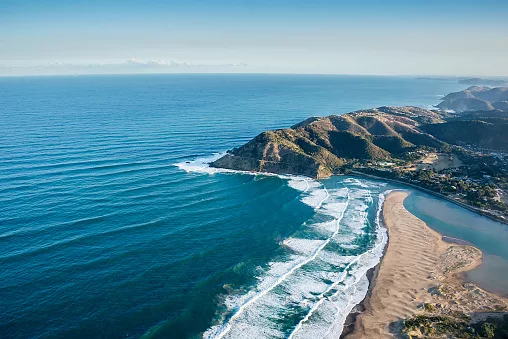
View of the mouth of the Umzimvubu River from the sky/By: wildestanimal/Getty Images
Explore the Wild Coast from cliffs and river mouths
Port St Johns offers perhaps the most rugged interpretation of the idea.
Known as the Jewel of the Wild Coast, the town sits between Mount Sullivan and Mount Thesiger at the mouth of the Umzimvubu River. Towering cliffs, subtropical vegetation and sandy river-mouth beaches create a coastline that feels far removed from conventional resort towns.
The landscape is particularly rewarding from above. A walk to Eagles Nest takes about an hour and leads to a viewpoint overlooking the town, while Mount Thesiger has a cliff-edge viewpoint that is used for picnics and sundowners.
Walk through the coastal landscape
Port St Johns has a network of walking routes, including trails around the town, coastal areas and nearby nature reserves. The local tourism organisation also lists routes such as the Lighthouse Circle and trails towards Mount Sullivan and Mount Thesiger.
Silaka Nature Reserve provides another way to experience the coast, with indigenous forest, short hikes, birding and rocky shoreline. The area is also home to wildlife including blue duiker and bushbuck.
Marine life remains part of the experience without requiring a boat. Dolphins are regularly seen offshore, while whales can be spotted seasonally. The combination of cliffs, river, forest and ocean is what makes Port St Johns particularly compelling for this kind of coastal escape.
6. St Lucia, KwaZulu-Natal
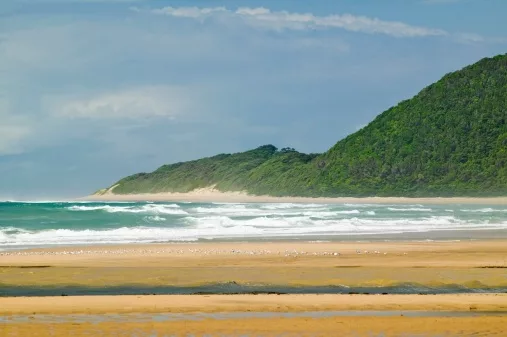
St Lucia/By: VisionsofAmerica/Joe Sohm/Getty Images
Experience the coast through wetlands and wildlife
St Lucia changes the definition of a coastal town completely.
Here, the Indian Ocean is part of a much larger wetland landscape. St Lucia sits beside the iSimangaliso Wetland Park, South Africa’s first World Heritage Site, where coastal forests, lakes, dunes, estuaries and marine environments form one interconnected ecosystem.
The nearby Lake St Lucia is an important estuarine system and one of the most significant wetland areas in South Africa. More than half of KwaZulu-Natal’s waterbirds feed, roost or nest around the lake, while its waters provide an important nursery for fish species.
Swap the beach towel for binoculars
The St Lucia area is ideal for travellers who want their coastal experience to include wildlife. Depending on where you explore, the landscape can bring sightings of hippos, crocodiles, antelope and a remarkable variety of birds.
The Western Shores and Charters Creek section of iSimangaliso offers views across Africa’s largest estuarine lake, while wildlife can include four of the Big Five in the surrounding landscape.
You can also explore the estuary on foot or from designated viewpoints, taking in mangroves, reeds and the changing landscape around the water.
Here, the ocean is not simply something to swim in. It is part of a vast ecological system where wetlands, wildlife and coastline meet.
A different way to experience the South African coast
These towns show that a coastal getaway does not have to revolve around swimming or sunbathing.
In Hermanus, the cliffs turn the ocean into a wildlife-watching theatre. Knysna reveals the relationship between estuary and sea. Mossel Bay combines cliffs with maritime history, while Cape St Francis puts the coastline beneath a historic lighthouse. Port St Johns brings the drama of the Wild Coast, and St Lucia shows how closely the ocean is connected to wetlands and wildlife.
The next time you visit South Africa’s coast, look beyond the sand. Some of the country’s most memorable ocean experiences begin where the land ends.
Follow us on social media for more travel news, inspiration, and guides. You can also tag us to be featured.
Instagram | Facebook | Twitter | Spotify
ALSO READ:
Wild & Wise in the Overberg: What to expect from the renosterveld retreats this year