



Across the continent, communities continue to preserve ancient practices, oral histories, and architectural wonders that haven’t (yet) made it onto the typical traveller’s radar. Some are newly inscribed UNESCO World Heritage Sites; others are quietly awaiting recognition. All of them deserve attention.
Here are seven lesser-known or emerging cultural landmarks—each one a portal into Africa’s past, present, and future.
1. The ǂKhomani Cultural Landscape – South Africa

Arri Raats, Kalahari Khomani San Bushman, Boesmansrus camp/South African Tourism from South Africa/Wikimedia Commons
Where: Kalahari Desert, Northern Cape
UNESCO Status: Inscribed in 2017
Tucked into the red sands of the Kalahari lies a cultural landscape unlike any other. Home to the ǂKhomani San, one of the last communities of South Africa’s First People, this vast desertscape is more than wilderness—it’s a living archive of ancient knowledge.
Rock engravings, migratory routes, foraging practices, and language are all preserved here, not in museums, but in the memories of elders and the footsteps of their descendants. It’s a fragile ecosystem of stories and survival.
Travel Tip: Stay in the Kgalagadi Transfrontier Park and arrange a guided walk with a San tracker. Listening to stories under the stars might be the most powerful history lesson you’ll ever have.
2. Asante Traditional Buildings – Ghana

The Kentinkrono shrine/Joy Agyepong/Wikimedia Commons
Where: Around Kumasi, Ghana
UNESCO Status: Inscribed in 1980, but under-visited
While the colonial forts of Ghana’s coast draw international attention, the Asante Traditional Buildings inland are often overlooked. Built from mud and timber, these shrines and homes reflect centuries of spiritual life and resistance in the Ashanti Empire.
What makes them truly special is their continued use. Each structure is actively maintained by local priests and artisans, using centuries-old techniques. In an era of disappearing traditions, this is living heritage at work.
Travel Tip: Visit during the Akwasidae Festival held every six weeks. It’s a chance to witness royal regalia, drumming, and community rituals that date back to the 17th century.
ALSO READ: South Africa’s must-visit historic neighbourhoods
3. Tsodilo Hills – Botswana

Tsodilo Hills/Joachim Huber/Wikimedia Commons
Where: Northwest Botswana, near the Namibian border
UNESCO Status: Inscribed as a cultural site in 2001
Often called the “Louvre of the Desert,” Tsodilo Hills is home to over 4,500 rock paintings spanning millennia. The San people regard these hills as sacred, believing them to be the first place created by the gods.
Despite their significance, Tsodilo sees only a trickle of visitors—largely due to its remote location. But that solitude is part of the magic. Here, culture and geology merge into a quiet kind of grandeur.
Travel Tip: Base yourself in Maun and hire a 4×4 or join a cultural tour. Local San guides offer invaluable insight into the symbolism of the art and the surrounding stories.
4. The Salt Routes of Ethiopia’s Afar Region

Men carving salt traditionally in the Asale desert (Afar region)/Charliefleurene/Wikimedia Commons
Where: Danakil Depression, Northern Ethiopia
UNESCO Status: On Tentative List
Imagine walking for days across one of the hottest places on Earth—leading a camel caravan, carrying nothing but salt. In Ethiopia’s Afar region, that’s not imagination—it’s daily life.
These ancient salt routes, carved into the alien landscape of the Danakil Depression, are among the oldest continually used trade paths on the planet. The Afar people have mined and transported salt here for generations, using methods passed down through oral history.
Travel Tip: This is not a trip for the faint-hearted. Extreme heat and limited infrastructure make it an expedition, not a holiday—but the reward is a glimpse into a world almost unchanged by time.
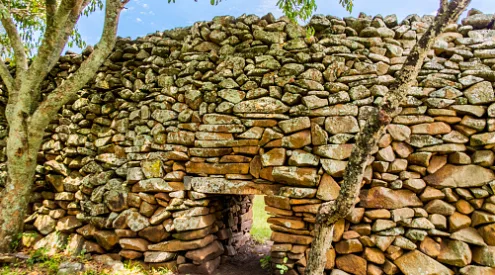
5. Khami Ruins – Zimbabwe

Khami Monuments/Todinirunganga/Wikimedia Commons
Where: 22km west of Bulawayo
UNESCO Status: Inscribed in 1986, often overshadowed
Most travellers to Zimbabwe flock to the Great Zimbabwe ruins—and for good reason. But few realise that just a few hours away lies Khami, the spiritual and architectural heir to that empire.
Built in the 15th century after the decline of Great Zimbabwe, Khami features finely terraced stonework, royal enclosures, and decorative wall patterns that reveal a sophisticated culture of hierarchy, trade, and artistry.
Travel Tip: Add Khami to your itinerary if you’re visiting Matobo Hills. The site is peaceful, uncrowded, and surrounded by baobab-studded landscapes.
6. Ennedi Massif – Chad

This freshwater spring attracts Toubou nomads and their goats to a canyon in the Ennedi Mountains of Chad, Central Africa/David Stanley from Nanaimo, Canada/Wikimedia Commons
Where: Northeast Chad
UNESCO Status: Inscribed in 2016 as a Mixed Site (natural + cultural)
This sandstone labyrinth in the heart of the Sahara is one of Africa’s most spectacular unknowns. Towering arches, ancient cave paintings and natural rock pools converge to form a surreal, sacred landscape.
The Ennedi is also a cultural refuge. Nomadic herders, mainly Toubou and Zaghawa people, still use these formations for water, shelter and ceremony. Despite its World Heritage status, it remains virtually untouched by tourism.
Travel Tip: You’ll need serious logistics: a fixer, permits, and desert-ready vehicles. But if you’re after the ultimate off-grid cultural immersion, this is it.
7. Mapungubwe Cultural Landscape – South Africa

Mapungubwe Cultural Landscape/Francesco Bandarin/Wikimedia Commons
Where: Limpopo Province
UNESCO Status: Inscribed in 2003
Mapungubwe was once the heart of a thriving Iron Age kingdom, where gold artefacts, glass beads and ivory moved between Africa and Asia. The site proves that long before colonial contact, southern Africa was part of a global trade network.
It’s not just the ruins that make Mapungubwe remarkable—it’s the sense of global connectedness stretching back over a thousand years. Today, visitors can explore its royal hilltop, museum, and the surrounding reserve teeming with wildlife.
Travel Tip: Book a heritage tour through Mapungubwe National Park and combine it with a stay in the Limpopo River Valley. The view from the confluence of South Africa, Botswana, and Zimbabwe is symbolic in more ways than one.
Follow us on social media for more travel news, inspiration, and guides. You can also tag us to be featured.
TikTok | Instagram | Facebook | Twitter
ALSO READ: Exploring South Africa’s ghost towns on gold & diamond trails



.jpg)


.jpg)
