






High above a river winding through the limestone cliffs of southern Spain, a narrow walkway clings to the walls of a spectacular gorge. Wooden boardwalks stretch along sheer rock faces, while a suspension bridge crosses a dizzying gap above the valley below.
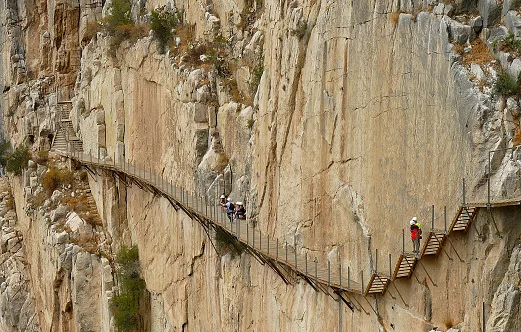
Caminito del Rey walkway hanging from the gorge of El Chorro above Guadalhorce river /By: Photo by Victor Ovies Arenas/Getty Images
This is the Caminito del Rey, or the King’s Little Pathway, a remarkable route through one of Andalusia’s most dramatic landscapes.
Today, it is a celebrated adventure tourism destination, attracting visitors with its extraordinary scenery and fascinating history. Yet the walkway was never intended for tourists. Built to serve the region’s hydroelectric industry in the early 20th century, it deteriorated over time, earning a reputation as one of the world’s most dangerous paths before an extensive restoration transformed it into a managed walking route.
A gorge shaped by water and time
Located in Málaga province, Andalusia, the Desfiladero de los Gaitanes is a spectacular natural passage carved by the Guadalhorce River. Towering limestone walls rise above the water, creating narrow passages, deep canyons and expansive views across the surrounding mountains.
In places, the gorge narrows to around 10 metres, while its dramatic rock faces reach hundreds of metres in height. The changing landscape gives the Caminito del Rey its distinctive character, taking walkers from open countryside into sections where cliffs rise almost vertically on either side.
The surrounding protected natural area is also home to diverse plant and animal life. Griffon vultures, Egyptian vultures and golden eagles may be spotted soaring above the cliffs, while the wider landscape supports wild boar and mountain goats.
The same rugged terrain that makes the gorge so impressive, however, once presented a considerable challenge to engineers working to harness the river’s power.
A walkway built for industry, not adventure
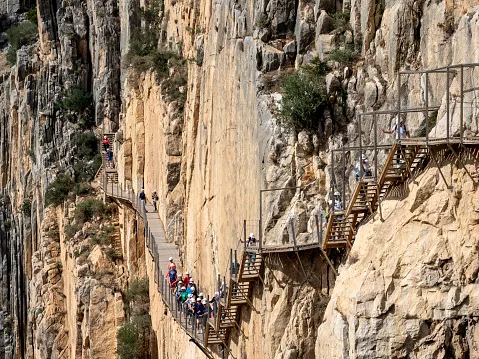
The King Walkway (El Caminito del Rey). The walkway is built into the side of the gorge of the Gaitanes (Desfiladero de los Gaitanes) Natural Area near the village of Ardales, Malaga Province, Andalusia, Spain/By: Jose A. Bernat Bacete/Getty Images
The hydroelectric origins of the King’s Path
Construction of the Caminito del Rey began in 1901 and was completed in 1905. Its original purpose was to connect hydroelectric installations near Gaitanejo and El Chorro, allowing workers to transport materials, reach equipment and maintain the infrastructure responsible for generating electricity.
The narrow service walkway was built directly along the gorge walls, providing access through terrain where constructing a conventional road would have been difficult. Its exposed position made it a remarkable feat of practical engineering, although its original function was far removed from the adventure tourism attraction it would eventually become.
The route acquired its royal name in 1921, when King Alfonso XIII crossed the walkway during a visit to inaugurate the Conde de Guadalhorce dam. From then on, it became popularly known as the Caminito del Rey, meaning the King’s Little Pathway.
From industrial route to dangerous relic
As the hydroelectric infrastructure evolved, the original walkway became less important, and maintenance declined. Exposure to the elements left the concrete deteriorating, protective barriers disappeared, and sections of the path crumbled away.
Despite its condition, the walkway attracted thrill-seekers drawn to its exposed position above the gorge. Its growing reputation was accompanied by danger, however, and fatal accidents in 1999 and 2000 helped prompt authorities to close access.
For years, the damaged route remained a symbol of both engineering ingenuity and neglect, its broken sections suspended against the cliffs. Its future would depend on finding a way to preserve the historic pathway while making the gorge accessible to visitors once again.
ALSO READ:
How restoration brought the King’s Path back to life
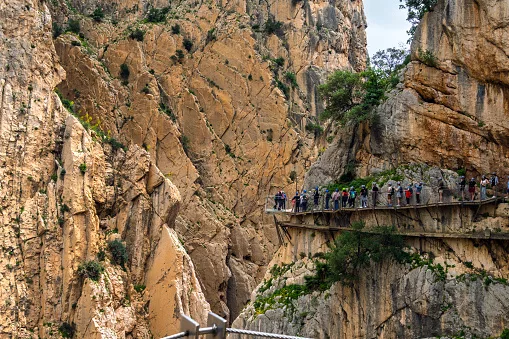
Caminito del Rey walkway hanging from the gorge of El Chorro above Guadalhorce river/By: Rosa María Fernández Rz/Getty Images
A major restoration project eventually transformed the Caminito del Rey into a managed visitor attraction. The restored route reopened in March 2015, with new wooden boardwalks, protective railings and modern safety measures installed along the gorge walls.
Rather than relying on the damaged original path, the new walkways were constructed above sections of the old structure. Remnants of the deteriorated route remain visible beneath parts of the modern boardwalk, offering visitors a striking reminder of the walkway’s industrial past.
The restoration preserved the dramatic setting while introducing controlled access and safety requirements. Visitors follow a designated route and wear protective helmets supplied at the entrance. The result is an experience that retains the excitement of walking high above a gorge without exposing visitors to the hazards of the abandoned pathway.
The reopening also helped establish the Caminito del Rey as a major attraction in Málaga province, bringing renewed attention to the surrounding natural landscape.
Walking between cliffs and sky
The modern Caminito del Rey follows a one-way route through the gorge, combining ordinary footpaths with elevated boardwalks attached directly to the limestone walls. The landscape changes along the way, from wooded valleys and open countryside to narrow canyon passages where the river lies far below.
The walkways are the route’s defining feature. As visitors move along the cliff faces, the scale of the gorge becomes increasingly apparent. Rock formations reveal the area’s geological history, while shifting light brings out the textures of the limestone.
Wildlife adds another dimension to the experience. Griffon vultures and other birds of prey may circle above the gorge, taking advantage of rising air currents, while the surrounding protected landscape provides habitat for a variety of species.
One of the route’s highlights is the suspension bridge near the southern end. Approximately 110 metres long, it spans a dramatic gap above the gorge, offering sweeping views of the surrounding cliffs and valley. For visitors comfortable with heights, the crossing provides a memorable finale to a walk that combines natural beauty with human engineering.
Planning a visit to Caminito del Rey
The Caminito del Rey lies in Málaga province, between the Ardales area to the north and El Chorro, near Álora, to the south. The linear route covers approximately 7.7 km and generally takes three to four hours to complete, including the approach and exit trails. Visitors should plan their transport, as the route does not return to its starting point. A shuttle bus connects the northern and southern access areas.
Tickets should be booked through the official Caminito del Rey website, particularly during busy travel periods. Visitors should arrive at least 30 minutes before their scheduled entry time and check the official guidance before setting out, as adverse weather or safety concerns can result in closures.
Comfortable, secure hiking shoes are essential, along with drinking water, sun protection and clothing suited to the weather. Helmets are provided and must be worn as instructed. Children under eight are not permitted, and the exposed walkways may be challenging for anyone who experiences significant vertigo.
Although the restored route is managed for visitor safety, its elevated position and narrow passages require care. Following the marked trail and staff instructions is essential to enjoying the experience responsibly.
A remarkable transformation
The Caminito del Rey is more than a dramatic walkway suspended above a Spanish gorge. It is a story of industrial ambition, deterioration and restoration, set within a landscape shaped by water over millions of years.
Built to serve the needs of a hydroelectric industry, the original path eventually became notorious for its dangerous condition. Its restoration has given it a new purpose, allowing travellers to experience the Gaitanes Gorge while preserving a tangible connection to its engineering history.
For those exploring Andalusia beyond its historic cities and Mediterranean coastline, the Caminito del Rey offers a memorable encounter with southern Spain’s rugged natural beauty, where a century-old industrial route has become an extraordinary adventure through the cliffs.
Follow us on social media for more travel news, inspiration, and guides. You can also tag us to be featured.
Instagram | Facebook | Twitter | Spotify
ALSO READ:
Ciudad Perdida: The ancient city hidden in Colombia’s jungle