


A discovery deep inside the caves of northern Saudi Arabia is rewriting what scientists thought they knew about cheetahs in the region and could influence how the species is reintroduced to the desert landscapes it once ruled, as reported by CNN.
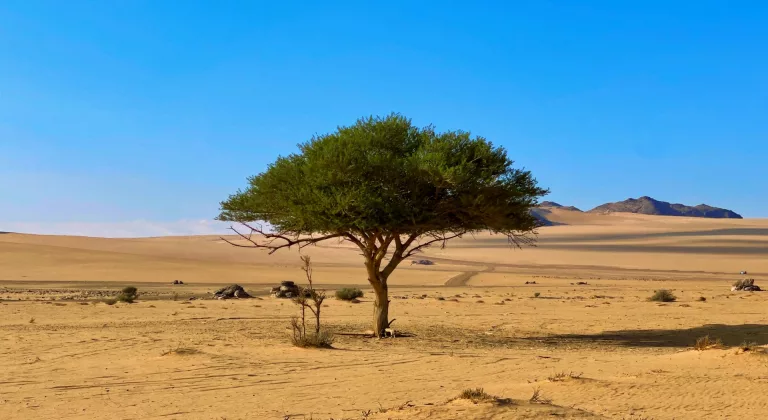
Arabian Peninsula/Rabah Al Shammary/Unsplash
During wildlife surveys conducted in 2022 and 2023, researchers from the National Centre for Wildlife made an unexpected find near the city of Arar: seven naturally mummified cheetahs preserved in five separate caves. Their soft tissue and skeletons were remarkably intact, a rarity for large predators and the first known example of natural cheetah mummification anywhere in the world.
What followed was even more surprising.
DNA reveals a forgotten cheetah story
Cheetahs once ranged across much of Africa and parts of Asia, but today they occupy just nine percent of their historical range. In the Arabian Peninsula, they were declared locally extinct by the 1970s. Until now, scientists believed that only one subspecies, the Asiatic cheetah, ever lived in Saudi Arabia. That subspecies is now critically endangered, with a tiny population clinging on in Iran.
DNA extracted from three of the mummified remains tells a different story.
Genetic analysis revealed that two of the oldest specimens were more closely related to the Northwest African cheetah, a subspecies previously thought to be confined to Africa. The findings, published in Communications Earth & Environment, confirm that at least two distinct cheetah lineages once roamed the Arabian Peninsula.
For conservationists, this detail matters. Knowing which cheetah lineages historically lived in the region provides a clearer blueprint for future reintroduction efforts.
ALSO READ:
Why were cheetahs using caves?
Equally puzzling is how the cheetahs ended up in caves at all. According to lead researcher Ahmed Al Boug, cave use is a highly unusual behaviour for cheetahs. Researchers do not believe the animals wandered in by accident or retreated there simply to die.
Instead, the caves’ hyper-arid conditions likely played a key role in preserving the remains over centuries, creating a natural time capsule of desert wildlife. Alongside the seven mummies, scientists also uncovered skeletal remains of at least 54 additional cats. Some date back nearly 4,000 years, while two of the mummified cheetahs lived as recently as 130 to 1,870 years ago.
The team plans to analyse more samples to better understand how cheetahs used this landscape over millennia.
A bridge, not a dead end
The discovery suggests that the Arabian Peninsula was not an ecological cul-de-sac for cheetahs but a vital corridor connecting Africa and Asia.
Adrian Tordiffe, a wildlife veterinary specialist and lecturer at the University of Pretoria but based in India, says the findings challenge long-held assumptions. The presence of multiple subspecies across different time periods shows that cheetahs were not merely passing through. They were breeding, thriving and forming stable populations alongside prey species such as gazelles.
That detail is especially significant as Saudi Arabia restores large protected areas and reintroduces native wildlife. With many historical threats, including overhunting and habitat loss, now reduced, conditions may once again support top predators.
cheetah conservation, Saudi Arabia wildlife, Arabian Peninsula rewilding, ancient DNA, desert ecosystems, cheetah reintroduction, wildlife archaeology
What this means for rewilding the desert
For organisations such as the Cheetah Conservation Fund, which partners with Saudi Arabia on cheetah reintroduction, the study provides long-sought clarity.
Cheetahs are more than charismatic hunters. As apex predators, they help regulate ecosystems, create feeding opportunities for smaller animals and contribute to overall biodiversity. Their confirmed long-term presence in the Arabian Peninsula strengthens the case for bringing them back, not as an experiment, but as a restoration of balance.
After decades of absence, the desert may be closer than ever to hearing the sprint of cheetahs once again.
Follow us on social media for more travel news, inspiration, and guides. You can also tag us to be featured.
TikTok | Instagram | Facebook | Twitter
ALSO READ: