


Survival in the wild is not always about being the biggest, fastest or strongest. Across Africa, animals have evolved ingenious ways to find food, escape predators and cope with conditions that would be impossible for many other creatures.
Some build elaborate traps from sand. Others navigate by the stars, harvest drinking water from fog or dig into dry riverbeds for hidden water. Even familiar animals such as chameleons have survival strategies that are more complicated than the clichés suggest.
Here are some of the wildlife world’s strangest survival tricks.
1. Antlions turn sand into a deadly trap
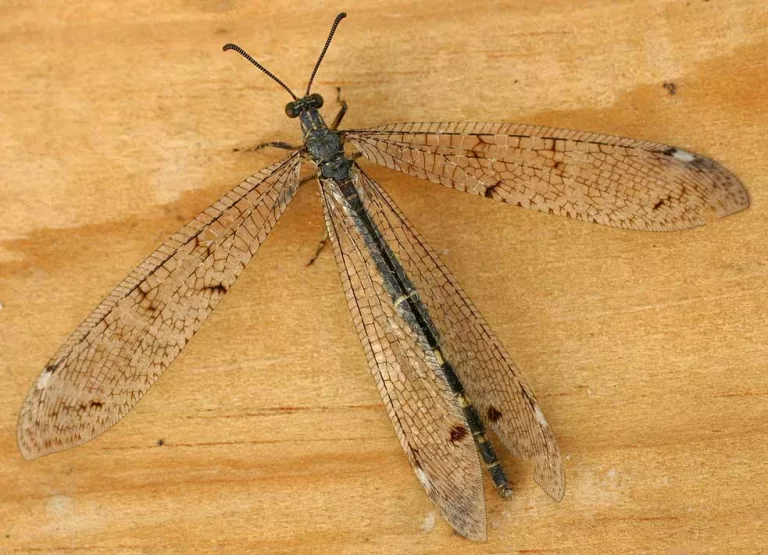
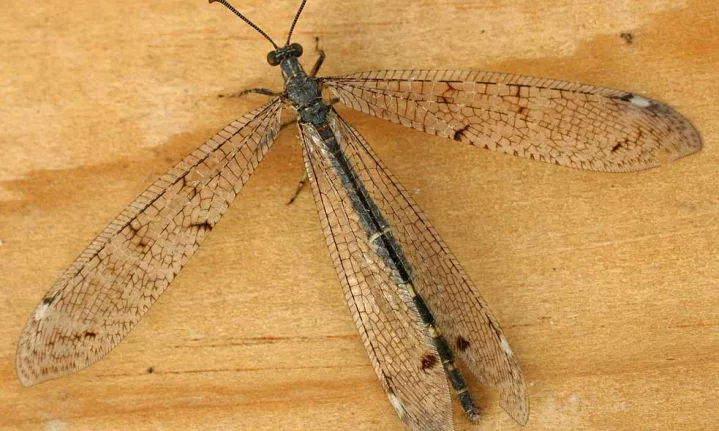
Antlion/Attribution: © entomart/Wikimedia Commons
A predator that lets the landscape do the hunting
An antlion larva does not need to chase its dinner. Instead, it builds a trap.
In loose, fine sand, the tiny predator digs a steep-sided, funnel-shaped pit by moving backwards in a spiral and flicking sand away with its head. Once the trap is complete, the antlion buries itself at the bottom, leaving its jaws ready for anything that tumbles in.
The design is remarkably effective. The steep slopes are close to the point of instability, meaning that an insect entering the pit can slide towards the centre and into the waiting predator.
And the antlion does not simply sit there hoping for dinner.
When prey struggles, the larva can throw sand up the sides of the pit, creating miniature landslides that make escape even harder and help shift the prey towards its jaws. The sand-throwing also helps maintain the shape of the trap.
It is essentially a tiny ambush predator that has turned a patch of sand into a hunting machine.
2. Dung beetles use the Milky Way as a compass
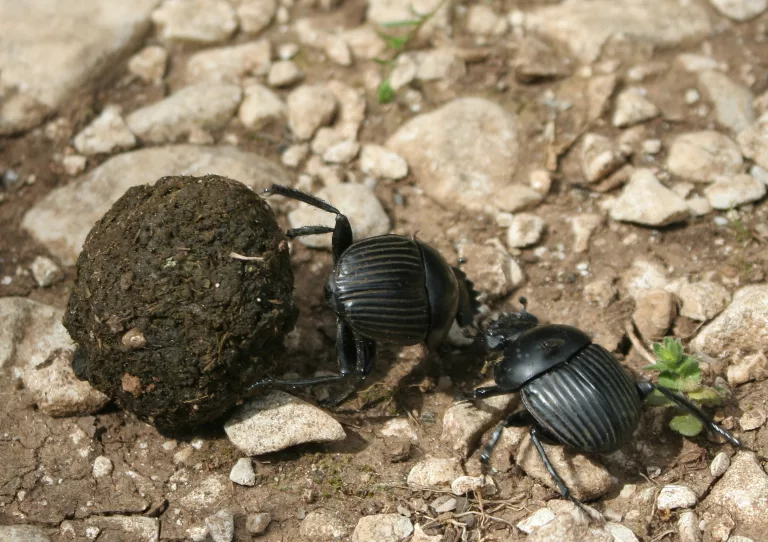
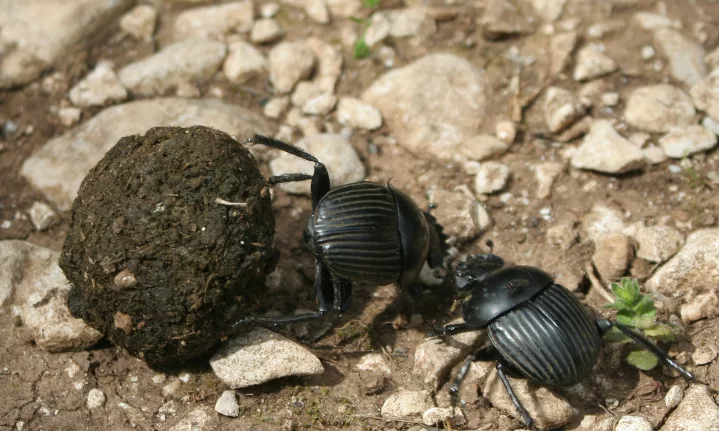
Dung Beetles/Rafael Brix/Wikimedia Commons
When the night sky becomes a navigation tool
Dung beetles already have an unusual job: finding animal dung, shaping it into balls and rolling it away before competitors can steal it.
But some African ball-rolling dung beetles have an even stranger advantage. They can use the night sky to maintain a straight path.
Research has shown that Scarabaeus satyrus can orient itself using the Milky Way, even when the moon is absent. Rather than navigating by individual stars, the beetles use the broad band of light created by the Milky Way as a celestial reference.
The trick matters because a straight escape route gets the beetle and its dung ball away from the crowded dung pile as quickly as possible.
For an animal only a few centimetres long, the night sky is effectively a giant navigation system.
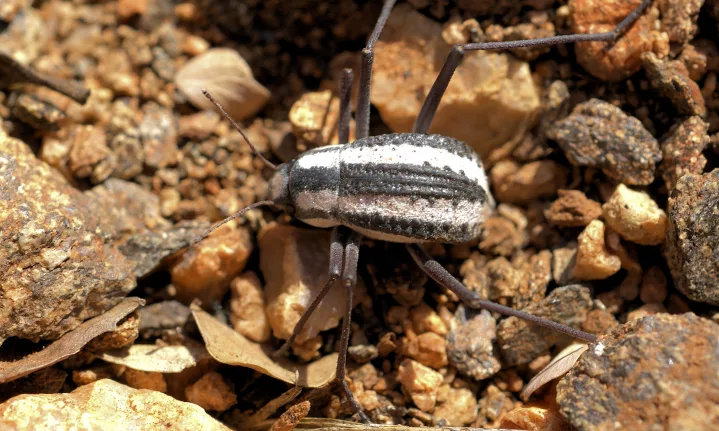
3. Namib Desert beetles drink from fog
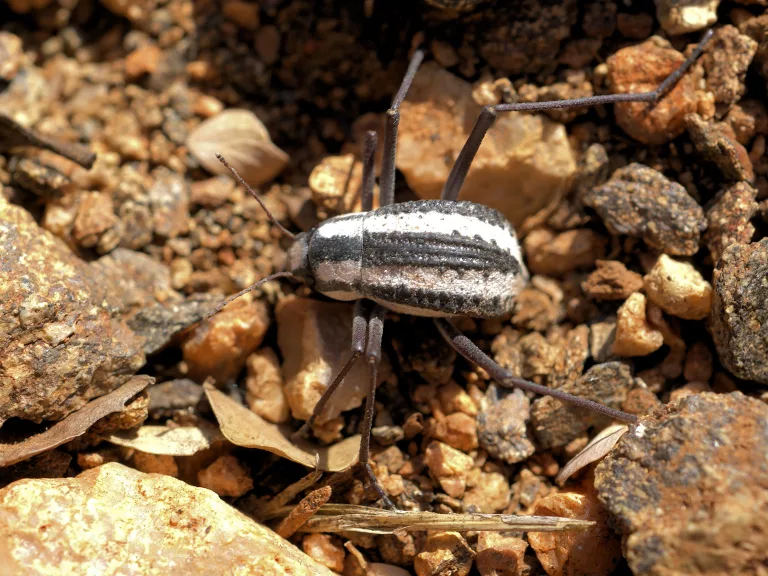
A Racing Stripe Darkling Beetle at Epupa Falls, Namibia/© Hans Hillewaert/Wikimedia Commons
Turning mist into a water supply
In one of the world’s driest environments, water can arrive without rain.
Namib Desert darkling beetles have evolved behaviours that allow them to collect moisture from fog. Some species climb dune ridges and adopt a distinctive head-down or headstanding posture, allowing droplets to form on their backs and run towards their mouths.
The technique is known as fog basking.
It is particularly useful in a landscape where rainfall can be extremely limited. Research has found that fog-basking behaviour itself can be more important than specialised surface structures when some of these beetles collect water.
The beetles effectively turn their own bodies into tiny water-collection systems.
Where to see this survival trick
The Namib’s fog belt, particularly around the coastal desert of Namibia, is one of the best places to appreciate just how dramatically wildlife can adapt to an arid environment.
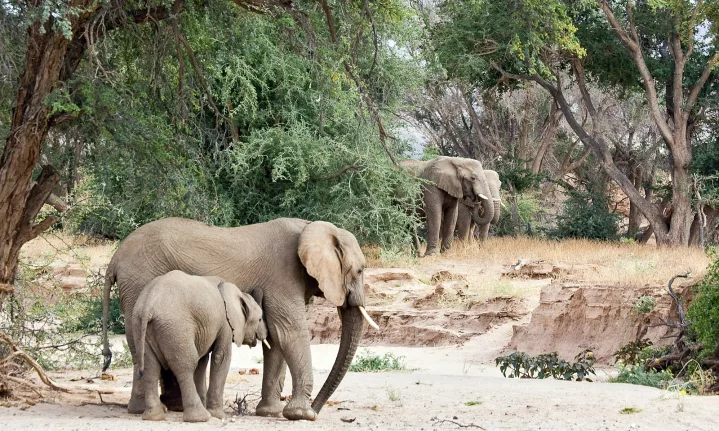
4. Desert elephants dig for hidden water
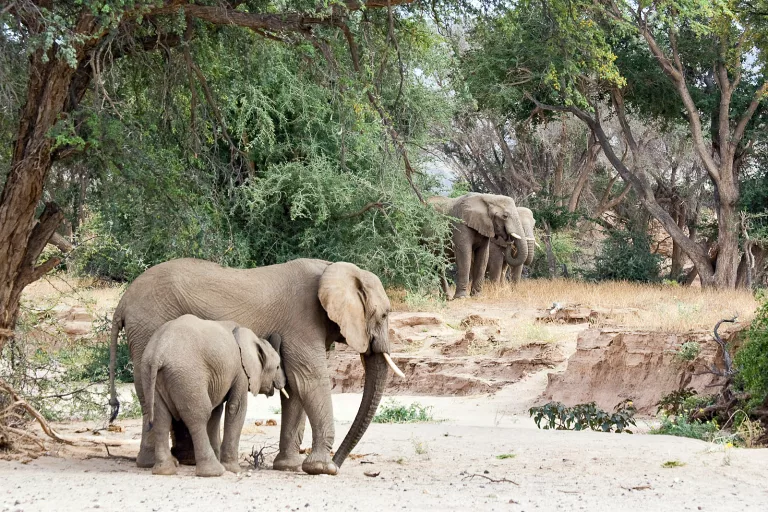
Desert elephants at the dried-up Huab River in Namibia/Greg Willis from Arlington, VA, USA/Wikimedia Commons
Finding what lies beneath a dry riverbed
North-western Namibia’s desert-dwelling elephants live in a landscape where water can be scarce and widely scattered.
One of their most remarkable survival tricks is digging wells in sandy riverbeds using their feet and trunks. These elephant-made wells can reach groundwater beneath apparently dry sections of rivers.
The behaviour can be more than simply a desperate search for water. Research comparing elephant wells with nearby surface water found lower faecal-coliform counts in the wells, suggesting that elephants may sometimes be seeking cleaner water beneath the surface.
Their digging can also benefit other animals. Once an elephant has opened up a water source, species such as springbok, jackals and baboons may use the wells too.
In a desert landscape, an elephant can therefore become both a water seeker and an accidental engineer.
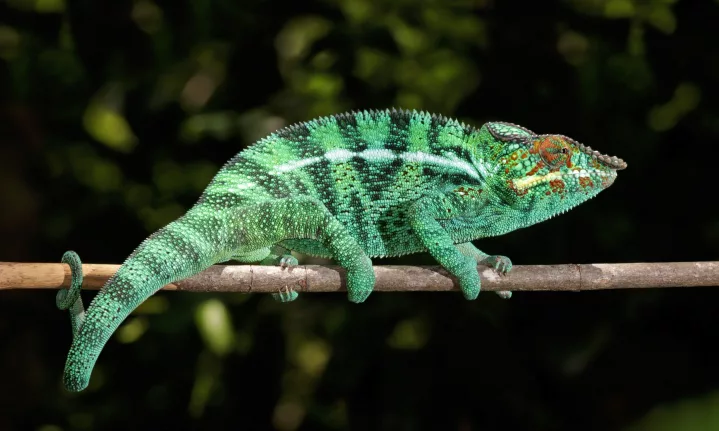
5. Chameleons change colour for more than camouflage
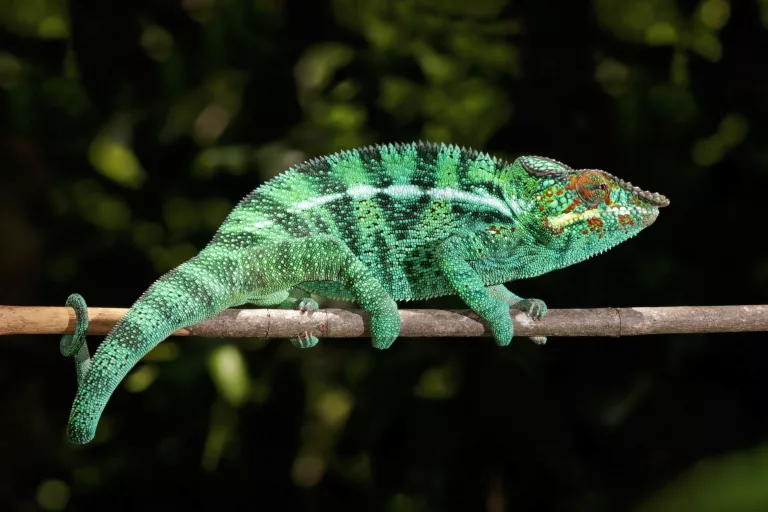
Panther chameleon/Charles J. Sharp/Wikimedia Commons
The colour-changing trick is more complicated than you think
Few animal adaptations are as famous as the chameleon’s ability to change colour.
But the popular image of a chameleon instantly becoming whatever colour happens to be behind it is an oversimplification. Colour change can play several roles, including camouflage, communication and thermoregulation.
Recent research on flap-necked chameleons found evidence that they can alter brightness and colour to improve camouflage against some backgrounds, although they do not simply reproduce every pattern around them.
That makes the adaptation even more interesting. Rather than being a simple invisible switch, colour change is part of a broader toolkit that helps chameleons manage their surroundings and interact with other animals.
Sometimes survival means disappearing.
Sometimes it means being noticed by exactly the right animal.
6. Aardwolves survive by specialising in termites
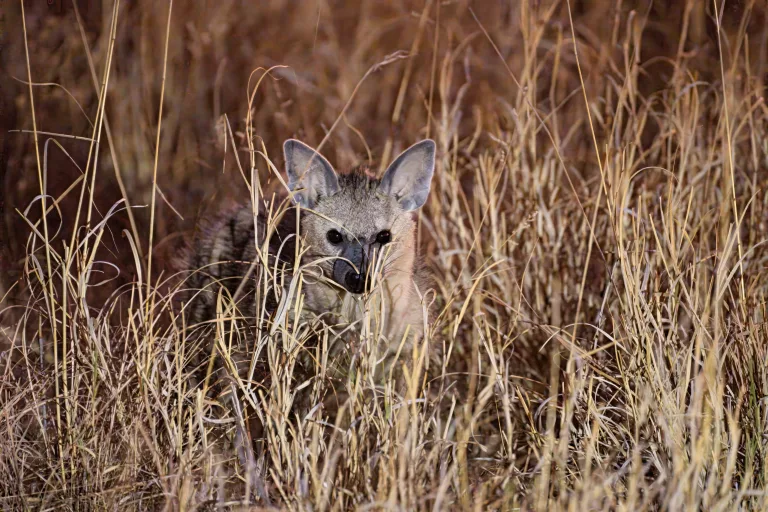
Image of aardwolf after sunset used for illustrative purposes/Eric Kilby from Somerville, MA, USA/Wikimedia Commions
The hyena relative that ignores most of the menu
An aardwolf might look like a small, unusually delicate hyena, but its lifestyle is very different.
Instead of tackling large prey, aardwolves specialise in eating termites. Their narrow feeding strategy allows them to exploit an abundant food source without competing directly with many of Africa’s larger predators.
It is a useful reminder that survival does not always require eating everything available. Sometimes the advantage lies in becoming exceptionally good at exploiting something other animals overlook.
For an animal living in environments where food availability can change dramatically, having a specialised niche can be an effective survival strategy.
7. Aardvarks turn the ground into a refuge
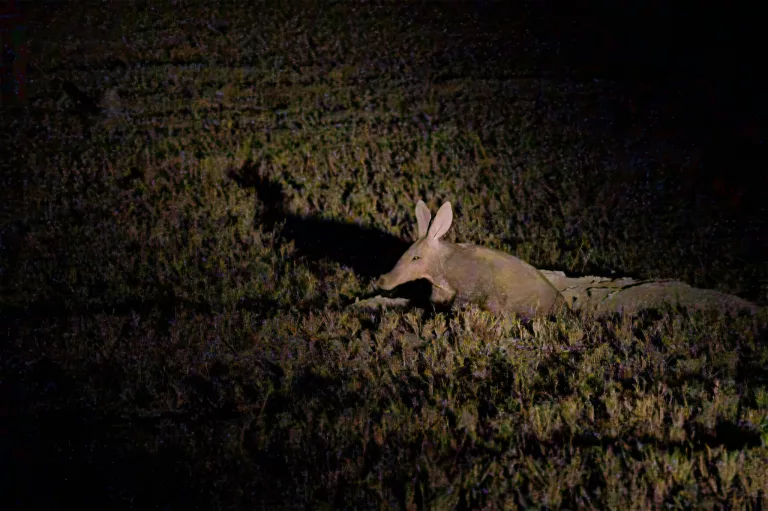
Aardvark in the Dark/Eric Kilby/Wikimedia Commons
Digging is both a feeding strategy and an escape plan
The aardvark’s survival toolkit begins with its powerful digging ability.
Its long claws and muscular limbs allow it to excavate termite mounds and ant nests in search of food. But digging also gives the nocturnal animal somewhere to escape the heat and danger of the African landscape.
Aardvark burrows can become important shelters for a surprisingly wide range of other species. Research and field observations have documented animals using these underground spaces as refuges, particularly during hot conditions.
In other words, an aardvark does not simply build a home for itself. Its digging can create an underground shelter system that becomes part of the wider ecosystem.
8. Desert animals survive by changing the rules
Life in extreme environments rewards unusual solutions
The most fascinating survival strategies often appear where conditions are hardest.
In the Namib, animals contend with extreme heat, scarce rainfall and unpredictable access to food and water. Some beetles harvest fog. Elephants dig into riverbeds. Other desert specialists minimise water loss, alter their activity patterns or retreat underground during the hottest parts of the day. Research on Namib beetles, for example, has found adaptations including behavioural thermoregulation and water-conserving features that help them cope with the desert environment.
These strategies show how evolution can work with whatever is available.
- A beetle gets water from fog.
- An elephant gets it from beneath the sand.
- An antlion turns sand into a weapon.
- A dung beetle reads the stars.
None of them needs to overpower the environment. They have simply found ways to work with it.
Survival is stranger than fiction
Wildlife watching often focuses on the spectacular: lions making a kill, elephants crossing a river or cheetahs chasing prey across open grassland.
But some of nature’s most extraordinary stories happen on a much smaller scale.
Look closely, and survival can mean building a microscopic engineering project in the sand, reading the Milky Way, collecting droplets from fog or remembering where water lies beneath a dry riverbed.
The next time you are on safari or exploring a desert landscape, it may be worth looking beyond the obvious wildlife. The strangest survival tricks are often happening quietly beneath your feet, in the sand, or high above you in the night sky.
Follow us on social media for more travel news, inspiration, and guides. You can also tag us to be featured.
Instagram | Facebook | Twitter | Spotify
ALSO READ:
6 spring road trips in South Africa worth getting behind the wheel for






_male_Nosy_Be.jpg)