
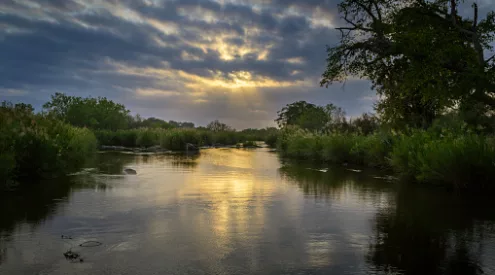
Few places make it easier to believe in monsters than Loch Ness. The water is dark, the loch is deep, and mist can swallow the surrounding Highlands in minutes.
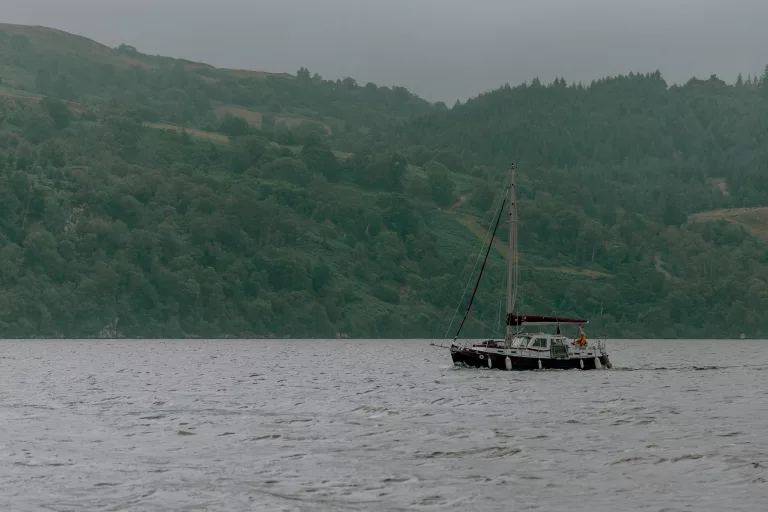
A peaceful boat sails on Loch Ness against Scotland’s lush, green coastal landscape / Wender Junior Souza Vieira / Pexels
Stretching for about 37km through Scotland’s Great Glen, it reaches depths of around 230m, leaving plenty of room for the imagination to run wild. For centuries, stories of strange creatures have been tied to these waters. But the famous monster we know as Nessie is a much more modern phenomenon. And the real story is almost as fascinating as the legend.
Before there was Nessie
The oldest story commonly linked to the monster dates to AD 565, when Irish missionary St Columba was reportedly confronted by a water beast while travelling near the River Ness.
The account appears in The Life of St Columba, written by Adomnán of Iona more than a century later. According to the story, a man had been attacked and killed by a creature in the river. Columba then ordered one of his companions into the water, where the beast appeared before retreating after Columba invoked God. It’s a good story, but it’s important not to turn it into something it was not.
The account describes a creature in the River Ness, not a monster living in Loch Ness. It was also written as part of a religious biography filled with miracles. Scotland already had a long tradition of supernatural water creatures, including kelpies and the each-uisge, a water horse said to lure people to their deaths. The modern Nessie legend came much later.
The year Nessie became famous
In 1933, reports of a strange creature in Loch Ness began appearing in newspapers. In May, Aldie Mackay, who managed the Drumnadrochit Hotel with her husband, reportedly saw an enormous creature moving in the water. The Inverness Courier published the account, describing it as resembling a whale.
More sightings followed. That same year, George Spicer and his wife claimed to have seen a large creature crossing the road in front of their car. Their description of a long-necked animal helped establish the image of Nessie that remains familiar today.
The timing was perfect for a legend to take off. Better roads were bringing more visitors into the Highlands, while newspapers were hungry for a strange story. Soon, people were travelling to Loch Ness specifically to search for the monster.
Then came the photograph.
The photograph that fooled the world
In April 1934, the Daily Mail published what became known as the ‘Surgeon’s Photograph’. The grainy image appeared to show a long-necked creature rising from the water. Because it was attributed to London surgeon Robert Kenneth Wilson, it carried an air of credibility that helped turn Nessie into an international phenomenon.
For decades, it was regarded as the strongest visual evidence of the monster. But it was also a hoax. The deception was eventually traced back to Marmaduke Wetherell, a big-game hunter who had previously been hired by the Daily Mail to investigate Nessie. After the newspaper rejected evidence he supplied, Wetherell reportedly set out to embarrass the paper.
A small model was built and attached to a toy submarine before being photographed on the loch. Wilson was then persuaded to submit the photographs. The Science Museum Group now records the famous image as a hoax, identifying the supposed monster as a putty-covered toy submarine. The photograph that made Nessie famous was never a photograph of Nessie.
So, what are people seeing?
That does not mean everyone who has reported seeing something in Loch Ness was lying. The loch is a difficult place to interpret from the shore. Its dark water, changing weather and poor visibility can turn an ordinary object into something much stranger.
Researchers have suggested that some sightings could have involved otters, deer, birds, floating logs or boat wakes. Long waves created by boats can travel across the loch and viewed from the right angle, resemble a series of humps moving through the water.
There is also the simple fact that people tend to see what they expect to see. Once a place is famous for a monster, a strange ripple is no longer just a strange ripple. It becomes a possible sighting.
That does not make the witness dishonest. It makes the human brain very good at turning uncertainty into a story.
Science has looked too
Nessie has not escaped scientific scrutiny. Sonar expeditions have searched the loch for decades. One of the largest, Operation Deepscan in 1987, used a fleet of boats to scan the loch’s depths. The expedition recorded several unexplained sonar contacts, but none could be confirmed as a large unknown animal.
Then came a more modern approach. In 2018, researchers led by University of Otago geneticist Neil Gemmell collected 250 water samples from different parts and depths of Loch Ness. The team was looking for environmental DNA, tiny traces of genetic material left behind by animals in the water.
They found no evidence of a plesiosaur, shark, catfish or sturgeon. They did find a lot of eel DNA.
The study could not determine how large those eels were, so the researchers could not completely dismiss the possibility that unusually large eels might explain some sightings. But there was no genetic evidence of a giant prehistoric creature hiding in the loch.
The mystery remains
After decades of sightings, sonar searches, photographs and scientific expeditions, there is still no convincing evidence that a giant unknown animal lives in Loch Ness. But standing beside the loch, that hardly seems like the point.
The water is dark enough to hide almost anything. Mist rolls across the Highlands, the ruins of Urquhart Castle watch from the shore, and every ripple disappears almost as quickly as it arrives.
Maybe Nessie was born from folklore, misidentification, newspaper headlines and one remarkably successful hoax. But the legend has become part of the landscape.
And if you find yourself standing beside Loch Ness, staring a little longer than you meant to, wondering whether that movement on the water was something more, you are not the first. You probably will not be the last.
Follow us on social media for more travel news, inspiration, and guides. You can also tag us to be featured.
Instagram | Facebook | Twitter | Spotify
ALSO READ:
World Octopus Day: 8 fascinating facts about one of the ocean’s strangest creatures