

A giant tortoise named Diego has quite the conservation legacy. After spending decades away from his island home, the centenarian helped father hundreds of offspring, playing a crucial role in bringing his species back from the brink of extinction.
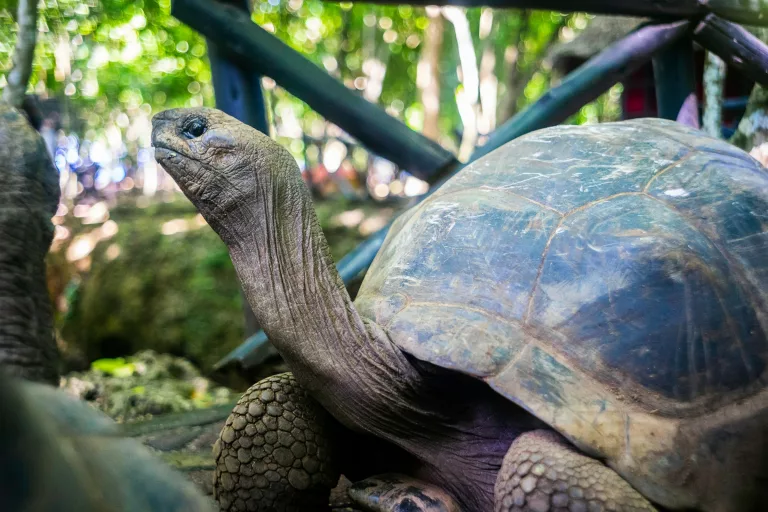
Photo: Unsplash / Image for illustrative purposes only. The tortoise pictured is not Diego.
According to AZ Animals, Diego fathered between 800 and 900 offspring during his time in a captive breeding programme. His contribution helped save the Española giant tortoise, also known as the Hood Island giant tortoise, from disappearing altogether.
It is a remarkable story of survival, and one that began long before Diego became a conservation success story.
A tortoise taken from home
Diego was removed from Española Island in Ecuador’s Galápagos archipelago during the 1930s, when giant tortoise populations across the islands were already under pressure from hunting and exploitation. He was taken to the San Diego Zoo in California, where he lived for more than four decades.
At the time, few could have imagined just how important this particular tortoise would become to the survival of his species.
By the 1960s, the Española giant tortoise population had reached a critical point. Researchers surveying the island found only 14 surviving individuals, comprising 12 females and two males. With no signs of the population recovering naturally, conservationists realised urgent intervention was needed.
A captive breeding programme was established on Santa Cruz Island, with the aim of rebuilding the population and eventually returning the tortoises to their natural habitat.
There was just one problem: the programme needed more breeding males.
In 1976, genetic testing at the San Diego Zoo revealed that Diego was an Española giant tortoise. His identity made him an important addition to the conservation effort, and he was transferred to the Galápagos in 1977 to join the breeding programme.
The unlikely conservation hero
Diego certainly made his contribution count.
Working alongside two other males and 12 females, he became one of the most successful breeders in the programme. His offspring eventually accounted for a significant proportion of the tortoises bred in captivity and returned to Española Island.
According to conservation research, Diego fathered almost 60% of the captive-bred hatchlings, while AZ Animals estimates his contribution at between 800 and 900 offspring.
He was not the only male responsible for the species’ recovery, however. The other breeding males also played important roles in increasing the population.
Over the following decades, young tortoises were raised in captivity before being released onto Española Island. By the 1990s, researchers were finding evidence that the animals were successfully breeding in the wild, a major milestone for a species that had come so close to extinction.
A long-awaited return to the Galápagos
After more than 80 years away from his birthplace, Diego finally returned home in June 2020.
The captive breeding programme, which had been running for more than five decades, was officially brought to a close after conservationists confirmed that the population had recovered sufficiently to sustain itself through natural reproduction.
Diego was among 15 original breeding tortoises released back onto Española Island, where he could spend his remaining years in the wild.
According to Galápagos Conservancy, the programme had resulted in the reintroduction of nearly 1,900 tortoises to their island of origin. By the time the original breeding adults returned home, more than 2,300 giant tortoises were living on Española.
It was a significant achievement for conservationists, and a particularly special homecoming for Diego, who had spent most of his life away from the island where he was born.
How conservation helped bring a species back
While Diego’s contribution was extraordinary, his story is also a reminder that successful conservation takes more than one animal.
The recovery of the Española giant tortoise depended on several important interventions. Hunting and the removal of tortoise eggs were prohibited, while conservationists worked to restore the island’s natural environment.
One of the biggest challenges was the presence of invasive goats, which had been introduced to the island centuries earlier. They stripped the vegetation that native tortoises relied on for food and altered the habitat.
The removal of these goats allowed native vegetation to recover, creating more suitable conditions for the tortoises to survive and reproduce.
The breeding programme, habitat restoration and protection of the island’s wildlife worked together to give the species a second chance.
Today, the Española giant tortoise population numbers in the thousands, with evidence of natural breeding in the wild. Although the recovery is a conservation success, the species remains classified as Critically Endangered, meaning continued protection is essential.
Diego’s story is a wonderful example of what sustained conservation efforts can achieve. A tortoise taken from his island as a young animal went on to play a significant role in saving his own kind, eventually returning home to a place where his descendants could roam freely.
Not bad for a tortoise who spent much of his life quietly going about his business.
ALSO SEE: Ancient horseshoe crabs documented in the Philippines for the first time
Ancient horseshoe crabs documented in the Philippines for the first time