

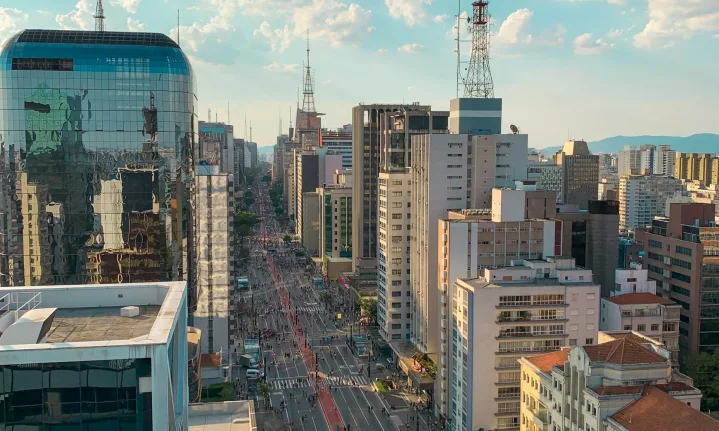
For six days a week, Avenida Paulista is concrete chaos. It is the financial spine of South America’s largest metropolis, where suit-clad executives power walk past skyscrapers and the relentless wave of cars, buses, and motorbikes choke the tarmac. But when Sunday morning arrives, the avenue closes completely to all vehicle traffic and transforms into a vibrant open-air pedestrian park.
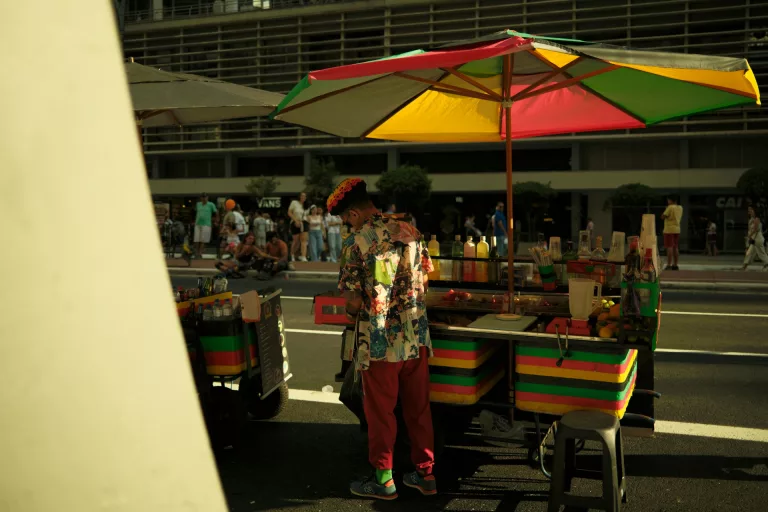
Image from the August – September 2026 print edition of GETAWAY.
At 8 am, the barriers go up, and one of the most congested arteries on the continent suddenly belongs entirely to the people. This weekly ritual, affectionately known as Paulista Aberta (Open Paulista), transforms nearly three kilometres of urban highway into São Paulo at its most unguarded: an inclusive, joyous counter-narrative to the city’s usual hustle and bustle.
Avenida Paulista on a Sunday is a benchmark of São Paulo life, from 10-piece brass bands blasting samba and impromptu circles of dancers to indie rock bands plugging their amplifiers into portable generators. There’s music around almost every corner, providing a dense, democratic, overlapping audio map where centuries of Brazilian musical heritage effortlessly blend with the city’s contemporary underground.
What makes this space profound is its diversity. In a city marked by stark socio-economic divides, Paulista Aberta acts as the great equaliser, hosting wealthy apartment dwellers from more affluent areas like Jardins or Pinheiros alongside families who have travelled over an hour by metro from the city’s outer peripheries.
Sunday on the avenue also offers immediate access to one of the most concentrated cultural spaces in Brazil: the architectural marvel of the Museum of Art of São Paulo (MASP). Suspended over a concrete plaza on massive red pillars, the building itself is a brutalist landmark designed by renowned Architect Lina Bo Bardi.
‘On Sundays, Avenida Paulista takes on a unique dynamic, bringing together culture, leisure and community life on one of São Paulo’s main thoroughfares,’ says Paulo Vicelli, the director of experiences and communication at MASP. ‘The street becomes an extension of the Vão Livre (a large open space in São Paulo), expanding the use of public space with free activities open to all, such as workshops, concerts and wellness initiatives.’
MASP arguably possesses the most important collection of European art in the Southern Hemisphere, offering the opportunity to see works by fundamental artists in art history, such as Pablo Picasso, Claude Monet and Vincent van Gogh. In addition, it features temporary exhibitions that engage with contemporary themes, famously displayed on clear glass easels that make the masterpieces appear to float in mid-air. ‘This year, the curatorial focus is Latin American Histories, with exhibitions presenting different perspectives on Latin American identity,’ Paulo adds.
Just a short walk down the pavement, spaces like Japan House São Paulo, designed by Kengo Kuma, offer serene, minimalist exhibitions, tearooms, and design shops that provide a quiet, contemplative contrast to the vibrance outside. Directly adjacent, the multi-storey Instituto Itaú Cultural attracts visitors with its immersive exhibitions about Brazilian identity, literature and visual arts.
While Paulista Aberta feels uniquely Brazilian, it is part of a massive, global shift in urban design. For nearly a century, cities worldwide were built with a single goal in mind: accommodating automobiles, as highways sliced through neighbourhoods and public spaces were sacrificed for smoother traffic flow. The tide is slowly turning as urban planners and global citizens’ movements are advocating for the concept of the ‘15-minute city’ and the reclamation of walkable spaces.
Bogotá’s legendary Ciclovía pioneered this idea, shutting down over 120 km of roads every Sunday. Further afield, Paris has aggressively pedestrianised the banks of the River Seine, and New York City has permanently turned major stretches of Times Square and Broadway over to foot traffic. Closing Avenida Paulista to cars is a radical act of urban wellness and encourages physical activity and spontaneous social interaction.
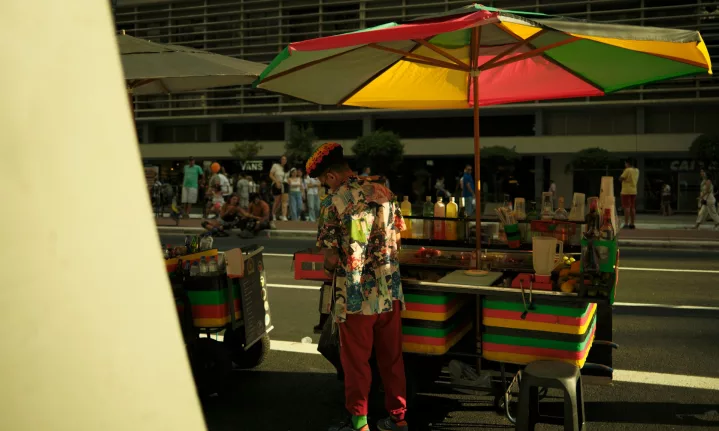
One of the main attractions of the open-air landscape is, of course, the irresistible aroma of street food, drifting from a sprawling network of mobile stalls. The true culinary anchor of the day is the feira (open-air street market) experience: from golden envelopes of pastéis (a deep-fried, ultra-crispy pastry filled with molten cheese, spiced ground beef or hearts of palm) to the easy-to-eat espetos (kebabs), traditionally washed down with a cold glass of caldo de cana (sugarcane juice freshly pressed through iron rollers) or the classic caipirinha. Beyond the traditional, the avenue becomes a global food hall, where you can grab everything from freshly hacked coconuts to gourmet food trucks serving up artisanal burgers and hot dogs to the crowds.
Reclaiming the road alongside the food stalls is also a thriving subculture of cyclists and micromobility enthusiasts. For a city notoriously hostile to two wheels during the workweek, Sunday turns the avenue into a high-visibility sanctuary for cyclists, rollerbladers and longboarders. Families teaching toddlers to ride on training wheels share the wide lanes with serious cycling clubs: a striking statement of reclamation, proving that when given the infrastructure, residents are more than ready to swap gridlock for the freedom of the open road.
When the festivities clear and the financial capital resumes its frantic pace, the true value of Paulista Aberta becomes obvious: breathing room within South America’s largest metropolis, bridging socio-economic divides, and offering a clear blueprint for modern, inclusive urbanism in practice.
Getting There
The metro is by far the easiest and most sustainable way to reach Avenida Paulista, bypassing the surrounding traffic gridlock. Line 2 (Green) runs directly underneath the avenue. You can hop off at Consolação, Trianon-Masp or Brigadeiro stations: any of these exits will deposit you right in the middle of the pedestrianised asphalt.
Where to Stay
Luxury:
Just a block off the avenue within the Cidade Matarazzo complex, Rosewood São Paulo is a striking property and a masterclass in green architecture and high design. Envisioned by French Architect Jean Nouvel with interiors by Philippe Starck, it offers an ultra-luxurious, oasis-like retreat steps from the Sunday energy.
Mid-range:
Blue Tree Premium Paulista is less than 200 m from the avenue and just a short walk from MASP, and offers comfortable, air-conditioned rooms, an indoor heated pool, and unmatched convenience for stepping straight out into the weekend festivities.
Insider tips for Paulista Aberta
Cash is King
While almost every major food truck and artisan accepts cards or Pix (a Brazilian instant payment system), having some loose Brazilian reais (R$) makes buying a quick coconut or pastel from the smaller, fast-moving street vendors seamless.
Keep an Eye on Your Valuables
Paulista Aberta is incredibly joyful and generally welcoming, but like any massive crowd in a major metropolis, pickpockets operate here. Keep your phone firmly in your pocket or a crossbody bag.
Time Your Visit
The barriers roll out at 8 am, and the street stays open until 4 pm. Hit the avenue before 11 am if you fancy a calmer stroll or bicycle ride, and arrive after 1 pm to experience the peak, high-energy festival atmosphere.
Originally published in the August – September 2026 print edition of GETAWAY.
Follow us on social media for more travel news, inspiration, and guides. You can also tag us to be featured.
Instagram | Facebook | Twitter | Spotify
ALSO READ:
Spring on the sandveld: De Wildeveldt’s luxury lodges on the West Coast