




A rare deep-sea shark has made an unusual appearance on the West Coast after its carcass washed up in the harbour area of St Helena Bay on Saturday, 22 August.
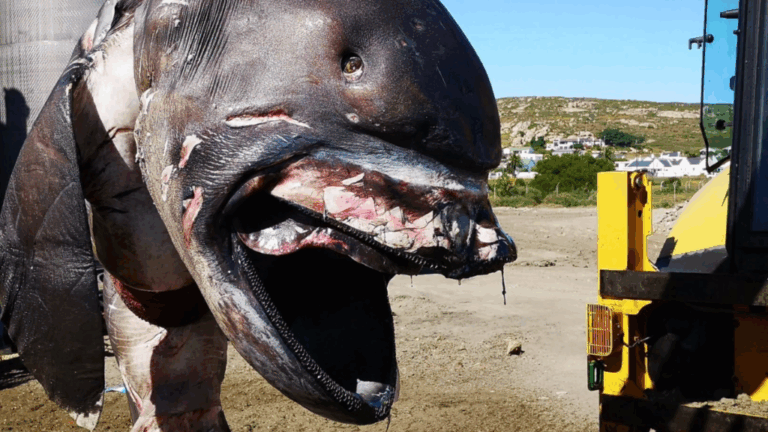
Picture: Danie Hefers and MoejahiednTaliep / Facebook
The megamouth shark had reportedly been swimming in the harbour for a short time before it eventually washed ashore near the Pioneer Fishing fish factory, Cape {town} Etc reports.
The unusual sighting was brought to the attention of Weslander by Velddrif environmental activist Ettienne Swanepoel of the Sandveld Wildlife Rehabilitation Centre (SWERF).
A shark rarely seen by people
Known scientifically as Megachasma pelagios, the megamouth shark is a deep-sea species that is rarely encountered.
The species can grow to around five metres in length and is easily recognised by its unusually large head and rubbery-looking lips.
It is one of just three living filter-feeding shark species. Like the much larger whale shark, it feeds by swimming with its mouth open and filtering food from the water.
Its diet includes small marine organisms such as krill, jellyfish, shrimp larvae, small crustaceans and crab larvae.
ALSO READ:
Why small-scale fishers want to save the African penguins at Stony Point
Researchers examine the carcass
The discovery has also provided an opportunity for researchers to learn more about a species that remains poorly understood.
The shark was kept at the fish factory while two senior researchers from the Department of Forestry, Fisheries and the Environment, Sarika Singh and Steven McCue, travelled from Cape Town to examine it.
Samples were taken from the carcass and will be studied at the department’s laboratory in Cape Town. The testing is expected to help determine, among other things, what may have caused the shark’s death.
Once the examination is complete, the carcass will be buried.
According to Singh, this is only the second megamouth shark found in South African waters, making the discovery particularly valuable for marine research.
One of only a handful of sightings
The megamouth shark was first discovered in 1976, and sightings of the species remain exceptionally uncommon.
According to the information provided, only around 300 megamouth sharks have been observed or caught since the species was identified.
That rarity means an unexpected appearance in a West Coast harbour is more than just an unusual local sighting. The carcass could provide researchers with an opportunity to gather information about a species that is rarely encountered alive.
Article shared by Cape Etc.
Follow us on social media for more travel news, inspiration, and guides. You can also tag us to be featured.
Instagram | Facebook | Twitter | Spotify
ALSO READ:
Father criticised after leaving exhausted seven-year-old behind on Mount Fuji