






South Africa’s story is etched not only in its landscapes but in its buildings. Wander through any town — from Stellenbosch’s thatched gables to Johannesburg’s concrete giants — and you’ll find architecture that mirrors the country’s evolving identity.
From Cape Dutch homesteads to raw Brutalist icons, here’s a look at the styles that shaped our skyline — and continue to define it.
Pre-colonial beginnings: Indigenous craft and function

Ndebele village in Mpumalanga/IpreachLove/Wikimedia Commons
Long before European gables rose in the Cape, local communities built ingenious structures shaped by climate and culture.
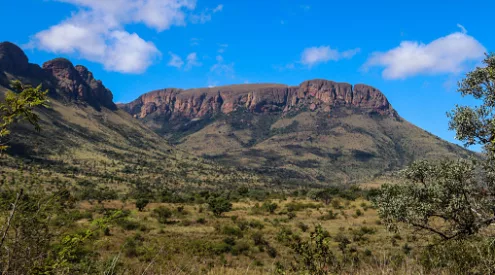
The Mapungubwe Kingdom’s stone walls in Limpopo (dating back to the 11th century) speak to early settlement planning and social hierarchy, while Ndebele homesteads in Mpumalanga and Limpopo still display vibrant geometric art — architecture as living storytelling.
These vernacular forms, built from mud, stone, and thatch, used locally available materials and reflected deep environmental awareness — lessons that sustainable architects are rediscovering today.
The grace of gables: Cape Dutch architecture (Late 1600s–1800s)

Groot Constantia homestead showcasing Cape Dutch architecture/Martinvl/Wikimedia Commons
Few architectural styles capture the imagination like the Cape Dutch. Born from European settlers adapting to the Cape’s Mediterranean climate, it blended Dutch, German, and Indonesian influences with local ingenuity.
Hallmarks include curved gables, whitewashed walls, thick thatch, and wooden sash windows.
At wine estates such as Groot Constantia, Rust en Vrede, and Blettermanhuis in Stellenbosch, symmetry and craftsmanship meet practicality — with cool interiors that offered refuge from the summer heat.
Even today, architects revisit this style through a modern lens: simple lines, tin roofs instead of thatch, and open-plan living that fuses nostalgia with contemporary ease.
Empire and ornament: Victorian and Edwardian flourish (1800s–Early 1900s)

Parliament of South Africa/Dietmar Rabich/Wikimedia Commons
With the arrival of British colonial rule came an explosion of ornament and grandeur. Iron lacework verandas, turrets, clock towers, and Gothic windows sprouted in rapidly growing port towns like Cape Town and Port Elizabeth.
The Waterfront Clock Tower stands as a whimsical Victorian landmark, while the Parliament Buildings and Union Buildings (both influenced by architect Sir Herbert Baker) brought neoclassical order and British imperial gravitas to civic architecture.
These were the boom years of railways, mining wealth, and empire — and the architecture made sure no one forgot it.
Modern Cape Vernacular: Nostalgia with a twist (Mid-1900s–present)
As the 20th century unfolded, the Cape Dutch look never truly disappeared — it evolved. Architects like Revel Fox and Gawie Fagan reinterpreted the old forms with modern materials and lighter proportions. You’ll find echoes of those whitewashed walls and symmetrical gables in contemporary wine estates and farm lodges across the Western Cape.
The revival speaks to a national affection for the familiar — a desire to blend heritage charm with the convenience and openness of modern living.
Modernism and the international style (1930s–1960s)

1 Thibault Square/Axxter99/Wikimedia Commons
After World War II, South Africa’s cities embraced modernism — clean lines, steel frames, and functional design that shunned ornamentation.
In Johannesburg, the Schlesinger Building embodied this sleek new age, while Cape Town’s 1 Thibault Square twisted its axis to soften the sun’s glare — a local adaptation of global ideals.
Modernist architects sought efficiency and progress, aiming for buildings to function like machines. But beneath the glass and concrete, their creations still reflected the optimism — and control — of a segregated society reshaping its urban core.
Concrete dreams: Brutalism’s bold statement (1960s–1980s)

Disa Park in Vredehoek, photographed from Signal Hill/Hilton Teper/Wikimedia Commons
Love it or loathe it, Brutalism left some of South Africa’s most unforgettable silhouettes. These raw, hulking structures — made of poured concrete, featuring geometric forms and monumental scale — mirrored the ambition and anxiety of their era.
Think of Ponte City in Johannesburg, a cylindrical tower both feared and admired; Disa Park’s “Pepper Pots” piercing Cape Town’s skyline; or Wartenweiler Library at UCT, its heavy facade balanced by intellectual purpose.
Even university campuses and government offices adopted the style — solid, uncompromising, and symbolic of permanence amid political uncertainty.
Today, these concrete giants are gaining new appreciation as icons of post-war modernity, with projects reimagining them as cultural and residential landmarks.
Contemporary and sustainable South African architecture (1990s–today)

Zeitz MOCAA Museum/Dietmar Rabich/Wikimedia Commons
Post-apartheid South Africa ushered in a new architectural ethos: diversity, innovation, and responsibility. Designers began experimenting with adaptive reuse and sustainability — converting, not demolishing, the past.
The Zeitz MOCAA Museum in Cape Town, carved from a 1920s grain silo by British architect Thomas Heatherwick, stands as a masterpiece of reinvention.
Across the country, projects like green schools in the Eastern Cape, eco-lodges in the Karoo, and urban regeneration initiatives in Johannesburg show how architecture is now used to heal — bridging history, community, and climate.
Our buildings, our story
From stone ruins to glass towers, South Africa’s architecture tells a story of resilience, reinvention, and reflection.
Each building — whether a farmhouse, church, or brutalist tower — captures a moment in our evolving sense of place.
To walk through these spaces is to travel through time: to trace how we’ve built, broken, and rebuilt again — always searching for beauty that endures.
Follow us on social media for more travel news, inspiration, and guides. You can also tag us to be featured.
TikTok | Instagram | Facebook | Twitter
ALSO READ: Historic Manor House at Steenberg Farm restored with elegant touches







,_Parliament_of_South_Africa_--_2024_--_3487.jpg)


,_Waterfront,_Zeitz_Museum_of_Contemporary_Art_Africa_--_2024_--_2980.jpg)