


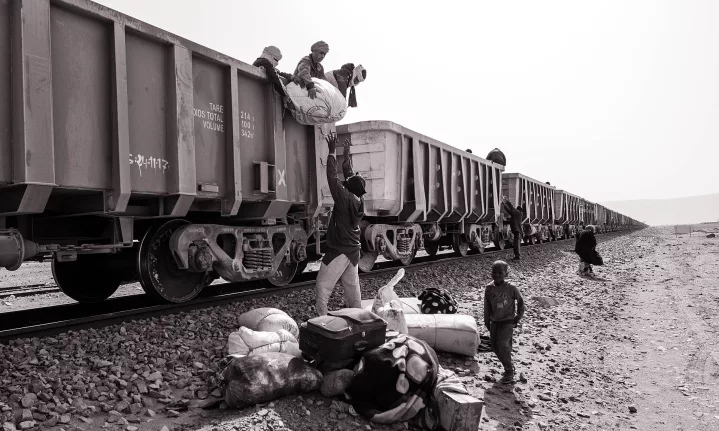
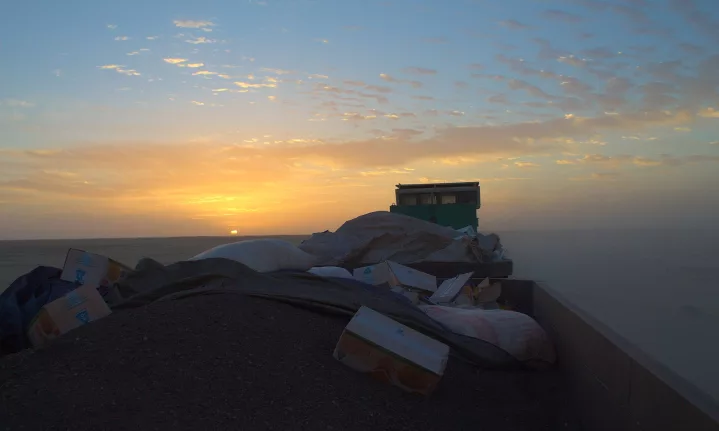
At first, there is mostly waiting. Somewhere in the Sahara, you stand beside a railway line and watch the desert stretch away in every direction. There are no platforms, cafés or neat departure boards. Just sand, rock, heat and a line of steel disappearing into the distance. Then the Iron Ore Train arrives.
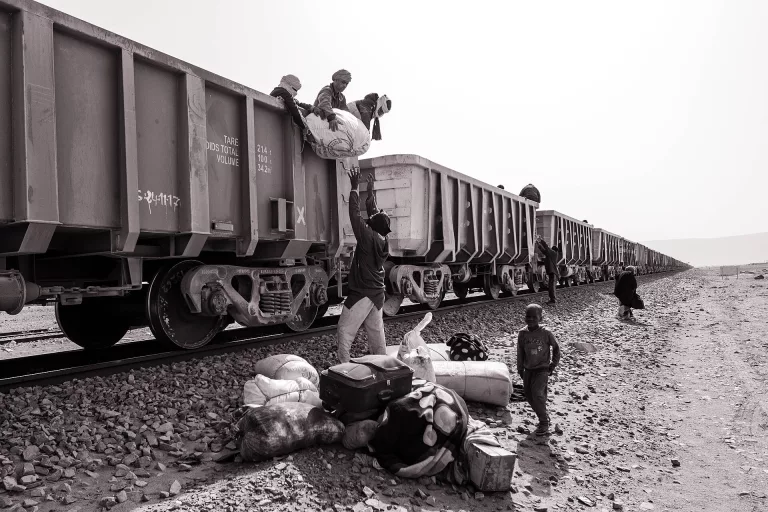
Travellers loading a wagon of the Mauritanian Iron Ore Train. Choum, Mauritania / Ben Kawam / Wikimedia Commons
It doesn’t feel like a normal train. Locomotives pull hundreds of freight wagons loaded with iron ore across northern Mauritania, creating a moving industrial giant that can stretch for several kilometres.
For the people who depend on it, this is transport and infrastructure. For a traveller, it’s a remarkably intimate way to experience the Sahara. And once the train starts moving, the landscape becomes the journey.
Into the desert
Mauritania’s railway was completed in 1963 to connect the iron ore mines around Zouérat with the Atlantic port of Nouadhibou. Today, the line runs for more than 700km across the Sahara and remains central to the country’s mining industry.
There is something strange about watching such a massive train move through such an empty landscape.
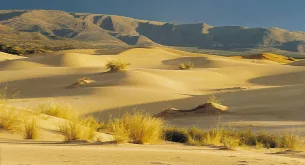
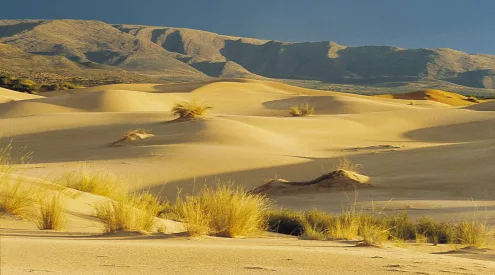
For long stretches, there is almost nothing outside the window. The desert changes slowly, from rocky plains to sand and distant ridges, while the tracks continue towards the coast.
You begin to notice small things.
The colour of the earth.
The way the light changes.
The silence between the movement of the train.
And the growing feeling of being very far from anywhere familiar.
The journey people dream about
For years, the Iron Ore Train became famous among adventurous travellers for another reason.
People climbed into the open ore wagons and crossed the Sahara sitting directly on the iron ore. Images of travellers covered in black dust, wrapped against the elements and surrounded by desert helped turn the railway into one of Africa’s most unusual travel experiences.
It looked wild because it was.
The journey could mean intense heat during the day, cold after sunset and clouds of iron-ore dust. There were no comforts of conventional rail travel, and the experience was as much about enduring the environment as seeing it. But that version of the journey is no longer something travellers should attempt.
The railway is operated by Société Nationale Industrielle et Minière (SNIM), Mauritania’s state-owned mining company, which runs the country’s major iron ore operations. In December 2024, SNIM formally warned against travelling in the ore wagons or on top of the iron ore, citing safety and health risks. Dedicated passenger cars are available instead.
That does not make the journey less interesting. If anything, it gives you a chance to see the train for what it really is: a working railway that happens to cross one of the world’s most extraordinary landscapes.
Life on the line
The most interesting part of the journey may be the people sharing it. This is not a railway built around tourism. The train exists because Mauritania’s mining industry needs to move iron ore from the interior to the coast.
SNIM sold more than 14.7 million tonnes of iron ore in 2025 and continues to invest in expanding its railway operations.
That changes the feeling of being aboard. You’re not simply passing through the Sahara as a spectator. You’re travelling along a route that has practical meaning for the country and for the communities connected to it.
There is something grounding about that. The desert might look empty from a distance, but the railway tells a different story. It’s a thread connecting remote mining country with the sea. People travel along it, goods move along it and, for more than six decades, the railway has formed part of everyday life in this corner of Mauritania.
A night beneath the Sahara
Eventually, the light fades.
The heat of the day gives way to the desert cold and the landscape outside becomes difficult to see. Without the glow of a city around you, the sky takes over.
This is when the journey feels most removed from ordinary life.
There is little to do but sit, watch and listen. The rhythm of the train becomes almost hypnotic. Metal moves against metal. The wheels keep time with the tracks. Outside, the Sahara disappears into darkness.
For a traveller, that slowness can be surprisingly welcome. There is no itinerary to follow and no landmark demanding your attention. Just the feeling of moving through somewhere vast.
It’s not an easy journey
The romance of the Iron Ore Train should not disguise the reality.
This is basic travel through a harsh environment, not a luxury rail experience. Conditions can be uncomfortable, information can change and arrangements should be confirmed locally rather than relying on old travel accounts.
The wider security situation also needs careful consideration. Current UK and US travel advisories warn of risks in parts of Mauritania, with some regions subject to stronger restrictions.
The journey also demands respect for the railway itself. The ore wagons are not a playground, and the most recognisable photographs from older travel stories should not be taken as instructions.
The experience is compelling without putting yourself in unnecessary danger.
The Sahara, slowly
There are easier ways to see the Sahara. There are organised desert tours, comfortable camps and four-wheel-drive excursions that can take you from one spectacular landscape to another.
The Iron Ore Train offers something different.
It makes you slow down. For hours, there may be nothing to photograph and nowhere to stop. You simply watch the desert pass, sharing a train with people for whom this railway is not an adventure but part of life.
And perhaps that’s what makes it memorable.The Iron Ore Train is not beautiful in the conventional sense. It’s noisy, dusty, industrial and sometimes uncomfortable.
But somewhere between the first glimpse of the locomotives and the last stretch of track disappearing into the desert, you begin to understand its appeal.
It’s not really about riding an unusual train, but about being carried through an enormous landscape slowly enough to feel its scale. Across the Sahara, with nothing but steel, sand and sky around you, the journey becomes the destination.
Follow us on social media for more travel news, inspiration, and guides. You can also tag us to be featured.
Instagram | Facebook | Twitter | Spotify
ALSO READ: