




Scientists have identified a small, spotted wild cat found as a kitten beside a road in Bolivia as a species new to science, more than 100 years after the last new wild cat species was described.
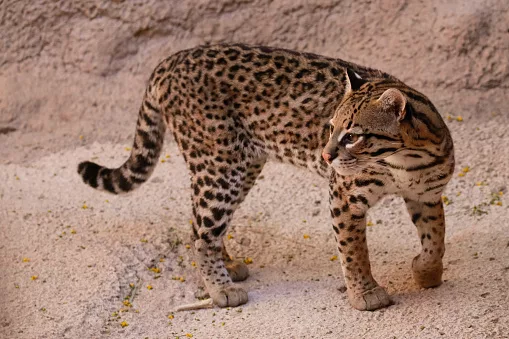
Image used for illustrative purposes/By: Mark Newman, Lonely Planet RF/Getty Images
The cat, now named Leopardus tilcayo, was discovered in Bolivia’s Yungas forest ecoregion, on the eastern slopes of the Andes. It is one of the world’s lesser-known small cats and weighs only around 1.4kg.
The discovery was formally described in a new study published in Current Biology, which also reveals that what scientists once considered a single widespread tiger cat species is actually made up of several distinct species.
It started with a ‘weird cat’
The story began in 2016 when Bolivian biologist and National Geographic Explorer Paola Nogales-Ascarrunz received a call from a wildlife sanctuary.
A local man had found the animal as a kitten on a road near a forest and taken it home, believing it was a domestic cat. After about a year, however, he realised the animal was clearly wild and better suited to a sanctuary.
Nogales-Ascarrunz, who founded the Bolivian Felids Research Program, went to see the animal at Senda Verde wildlife sanctuary.
She immediately noticed that it was unusual.
The cat had a small face, short rounded ears, long whiskers and a slender body covered in leopard-like spots.
“I took a hundred pictures of it,” Nogales-Ascarrunz recalled.
At the time, she believed the mysterious cat was a tiger cat, Leopardus tigrinus, a small spotted feline known by names including tigrina, oncilla and little spotted cat.
ALSO READ:
Hogsback after winter: Following the Amathole Mountains into spring
A strange difference in its spots
It was not until several years later that Nogales-Ascarrunz began to suspect something was different about the animal.
In 2019, while preparing a booklet about Bolivia’s wild cats, she compared her photographs with reference images of tiger cats from neighbouring Brazil.
The difference was striking.
The Bolivian cat had much larger rosettes than those seen on the Brazilian animals.
That observation eventually led researchers to investigate the animal’s genetics.
Working with geneticist Eduardo Eizirik of Pontifical Catholic University of Rio Grande do Sul in Brazil and study co-lead author Jonas Lescroart of the University of Antwerp, Nogales-Ascarrunz compared genomic data from 38 individuals across the Leopardus genus.
The results showed that the Bolivian cat was genetically distinct from the other tiger cats.
Researchers estimate that L. tilcayo diverged from the other tiger cat species around 1.4 million years ago, revealing an evolutionary history that could not be identified simply by looking at photographs.
A new branch on the cat family tree
The discovery is significant because it is not simply a previously recognised subspecies being elevated to species status.
Instead, Leopardus tilcayo is being described as a species that was previously unknown to science.
It is also the first new wild cat species described in more than a century. The last new species of wild cat to be described was the pampas cat in 1923.
The research has also changed scientists’ understanding of the tiger cat group.
What was once considered a single widespread species has increasingly been found to be a complex of genetically distinct species. The new study brings the number of recognised tiger cat species to five and provides evidence for a new tiger cat subspecies in Peru.
The researchers believe similar genetic investigations could reveal further hidden diversity among small wild cats elsewhere in the world.
Why the discovery matters for conservation
Identifying different species is more than a matter of updating scientific records. It can directly affect conservation decisions.
If tiger cats are considered one widespread species stretching across a large part of Central and South America, their overall population may appear relatively secure.
But if that population is actually divided among several distinct species, each species may have a much smaller distribution and population than previously thought.
Scientists still do not know how many Tilcayo cats remain in the wild.
Researchers currently know that the species occurs in Bolivia’s Yungas forest ecoregion, but many basic questions remain unanswered, including what the cats eat, how they reproduce and what threats they face.
The Yungas forests themselves are under pressure from habitat loss, making a better understanding of the newly described cat particularly important.
There could be more cats waiting to be found
Small wild cats are notoriously difficult to study. Unlike larger and more recognisable species such as lions and tigers, they are elusive and can be difficult to distinguish from closely related cats in the wild.
Even museum specimens have occasionally been misidentified.
Modern genomic analysis is giving researchers a new way to uncover these hidden differences, potentially changing our understanding of small wild cats around the world.
Researchers involved in the study believe the same methods could eventually reveal additional species in Africa and Asia.
For Nogales-Ascarrunz, the discovery is a reminder that there is still plenty left to learn about the natural world.
Even after centuries of scientific exploration, a previously unknown wild cat was living in a Bolivian forest, hiding in plain sight.
And now that scientists know it is there, the next challenge is finding out how many Tilcayo cats remain and ensuring their forest habitat is protected.
SOURCE: National Geographic
Follow us on social media for more travel news, inspiration, and guides. You can also tag us to be featured.
Instagram | Facebook | Twitter | Spotify
ALSO READ:
Olympic rowing venue home to 500 crocodiles gets the green light