
Tiny, round and famous for its squeaky call, the desert rain frog has become one of southern Africa’s latest conservation concerns, according to Mongabay reports.
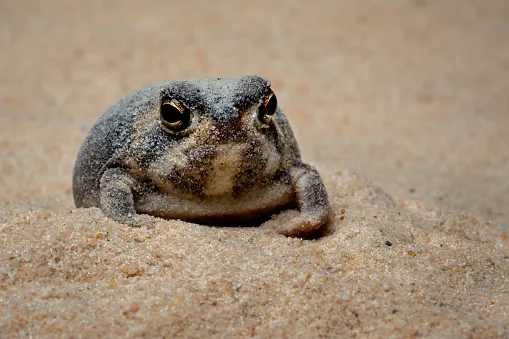
Desert rain frog/By: Tanto Yensen/iStock
The iconic amphibian (Breviceps macrops), found only along the coastal dunes of South Africa and Namibia, has officially been reclassified from Near Threatened to Vulnerable on the International Union for Conservation of Nature (IUCN) Red List.
The updated conservation status follows assessments by scientists from several southern African universities and conservation organisations, who warn that the species faces increasing pressure from mining, large-scale infrastructure projects and climate change.
A frog found nowhere else
Growing to just 4–6 cm long, the desert rain frog occupies a remarkably small range. It lives in the white coastal dunes of northern South Africa and southern Namibia, rarely venturing more than 10–12 km inland.
Unlike many amphibians, it doesn’t rely on permanent freshwater. Instead, it survives by absorbing moisture from coastal fog and spends much of its life hidden beneath cool, damp sand, emerging only when conditions are favourable.
Scientists have identified just six key habitat areas within the biodiverse Succulent Karoo biome, one of the world’s recognised biodiversity hotspots.
ALSO READ:
Learn something new: Cape Town’s most inspiring hands-on workshops and creative classes
Mining and development threaten fragile habitat
Much of the frog’s habitat has already been affected by open-cast diamond mining, which removes the coastal dunes and vegetation the species depends on. Although mining companies restore the sand after extraction, research suggests the native vegetation does not recover sufficiently for the frogs to return.
Conservationists are also concerned about the proposed Boegoebaai Green Hydrogen Project and its associated infrastructure, which could further fragment the frog’s already limited habitat.
Jeanne Tarrant, Executive Director of Anura Africa and Regional Co-chair of the IUCN Amphibian Specialist Group for Southern Africa, said the species has already lost habitat to mining and now faces additional pressures from future developments.
Because the frogs spend most of their lives burrowed beneath the sand, large-scale construction could have significant impacts on their survival.
Climate change adds another challenge
Rising temperatures and increasingly dry conditions are expected to place even more stress on the species in the coming decades.
IUCN assessors estimate that within the next 20 years, up to a third of the frog’s habitat in South Africa and nearly two-thirds of its Namibian range could be compromised. This could contribute to a population decline of around 20% over the next decade.
Conservation efforts needed
Despite its growing conservation concerns, there is currently no coordinated recovery programme for the desert rain frog.
Researchers have now begun a Green Status assessment through the IUCN, which evaluates a species’ potential for recovery and helps identify priority conservation actions.
Conservationists hope the frog’s new Vulnerable status will help drive greater research, habitat protection and long-term conservation efforts before further declines occur.
Follow us on social media for more travel news, inspiration, and guides. You can also tag us to be featured.
Instagram | Facebook | Twitter | Spotify
ALSO READ: