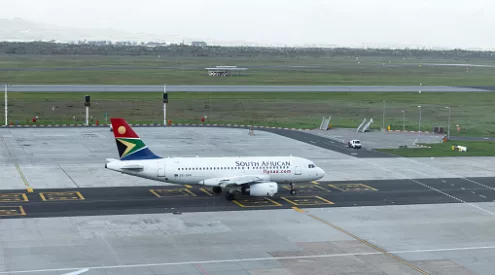




A global travel shake-up is quietly redirecting tourists south
Tourism patterns rarely shift overnight, but global instability has a way of rewriting the map.
As tensions continue to disrupt key Middle Eastern air corridors, international travel is being forced into new patterns. Major hubs like Dubai and Doha have experienced operational pressure, leaving airlines and passengers to rethink familiar routes between Europe, Asia, and Africa.
Sourced: X{@cgtnafrica}
According to SA People, the ripple effects of these disruptions are already visible, with travellers cancelling trips, rerouting journeys, and searching for destinations that offer more stability.
And increasingly, that search is pointing south.
Southern Africa quietly steps into the spotlight
With global uncertainty reshaping air travel, Southern Africa is emerging as a surprising beneficiary.
The region’s appeal is simple but powerful: it remains largely stable, accessible, and rich in long-haul tourism experiences. That combination is becoming more attractive as travellers grow cautious about unpredictable transit routes.
Tourism officials across the region say the shift is not speculative—it’s already happening in booking patterns and travel planning discussions.
For many travellers, especially those connecting through Europe and Asia, avoiding unstable transit hubs is becoming a priority rather than a preference.
South Africa’s tourism numbers show steady but uneven recovery
Recent data from Statistics South Africa shows that international arrivals are growing, but not evenly across markets.
In February 2026:
Total arrivals reached 864,534, up 13.1% year-on-year
Arrivals are 8.5% higher than 2019 levels
However, the growth is driven mainly by African travellers, who made up 640,781 arrivals.
Overseas markets tell a different story:
Total overseas arrivals: 222,978
Only 3.3% above 2025 levels
Still 9.5% below pre-pandemic levels
The recovery picture is uneven, and that’s where opportunity—and risk—now sits.
Where the opportunity is hiding: Europe, Asia and the Middle East
Not all markets are rebounding at the same pace.
Europe is close to full recovery at 95.7% of 2019 levels, but Asia and the Middle East remain significantly behind:
Asia: 61.1% of pre-pandemic levels
Middle East: 49.3% of pre-pandemic levels
These gaps matter. They show where travel demand is still fragile—and where disruption can easily reshape behaviour.
If instability continues along Middle Eastern routes, long-haul travellers may increasingly look for alternative destinations that avoid complex transit networks.
South Africa is one of those alternatives.
Why Southern Africa is suddenly in the conversation
Beyond South Africa, neighbouring destinations are also sensing opportunity.
In Zimbabwe, tourism stakeholders are already discussing how shifting global routes could benefit the region. Operators believe Southern Africa’s stability is becoming a competitive advantage at a time when predictability matters more than ever.
A key attraction is how naturally the region works as a combined itinerary. South Africa and Zimbabwe, for example, are often linked through experiences such as Victoria Falls and regional safari circuits.
This kind of multi-country travel is exactly what modern tourists are seeking: more value, more variety, and fewer complicated connections through unstable hubs.
The real driver: travellers are choosing certainty over convenience
The biggest shift in global tourism right now isn’t just about geography—it’s about psychology.
Travellers are increasingly prioritising:
Stable routes
Predictable connections
Multi-experience destinations
Lower exposure to transit disruption
Southern Africa fits this mindset. Visitors can move between cities, wildlife reserves, coastlines, and cultural hubs without navigating high-risk transit zones.
But there is still a catch: connectivity and pricing remain crucial. Even if demand shifts, airlines still determine how easily tourists can act on that interest.
A region watching for its moment
The United Nations tourism body is working alongside aviation organisations like International Civil Aviation Organization and International Air Transport Association to stabilise global routes and restore confidence.
Until then, uncertainty continues to reshape travel decisions in real time.
For Southern Africa, this moment represents more than a temporary boost—it’s a chance to reposition itself as a reliable global tourism hub.
A turning point for global tourism flows
What’s unfolding is not just disruption—it’s redistribution.
As Middle Eastern travel corridors face pressure, demand is quietly shifting toward regions that offer consistency. South Africa, with its infrastructure, diversity, and relative stability, now finds itself in a stronger global conversation than before.
Whether this becomes a short-term adjustment or a long-term shift will depend on how airlines, governments, and tourism bodies respond.
But for now, one trend is clear: in a world of uncertain skies, travellers are looking south.
This website uses cookies to improve your experience while you navigate through the website. Out of these, the cookies that are categorized as necessary are stored on your browser as they are essential for the working of basic functionalities of the website. We also use third-party cookies that help us analyze and understand how you use this website. These cookies will be stored in your browser only with your consent. You also have the option to opt-out of these cookies. But opting out of some of these cookies may affect your browsing experience.
Necessary cookies are absolutely essential for the website to function properly. These cookies ensure basic functionalities and security features of the website, anonymously.
Cookie
Duration
Description
cookielawinfo-checkbox-analytics
11 months
This cookie is set by GDPR Cookie Consent plugin. The cookie is used to store the user consent for the cookies in the category "Analytics".
cookielawinfo-checkbox-functional
11 months
The cookie is set by GDPR cookie consent to record the user consent for the cookies in the category "Functional".
cookielawinfo-checkbox-necessary
11 months
This cookie is set by GDPR Cookie Consent plugin. The cookies is used to store the user consent for the cookies in the category "Necessary".
cookielawinfo-checkbox-others
11 months
This cookie is set by GDPR Cookie Consent plugin. The cookie is used to store the user consent for the cookies in the category "Other.
cookielawinfo-checkbox-performance
11 months
This cookie is set by GDPR Cookie Consent plugin. The cookie is used to store the user consent for the cookies in the category "Performance".
viewed_cookie_policy
11 months
The cookie is set by the GDPR Cookie Consent plugin and is used to store whether or not user has consented to the use of cookies. It does not store any personal data.
Functional cookies help to perform certain functionalities like sharing the content of the website on social media platforms, collect feedbacks, and other third-party features.
Performance cookies are used to understand and analyze the key performance indexes of the website which helps in delivering a better user experience for the visitors.
Analytical cookies are used to understand how visitors interact with the website. These cookies help provide information on metrics the number of visitors, bounce rate, traffic source, etc.
Advertisement cookies are used to provide visitors with relevant ads and marketing campaigns. These cookies track visitors across websites and collect information to provide customized ads.