

How surfer and journalist Miles Masterson came to write the biography of John ‘The Oom’ Whitmore, the man who helped to establish South African beach culture.
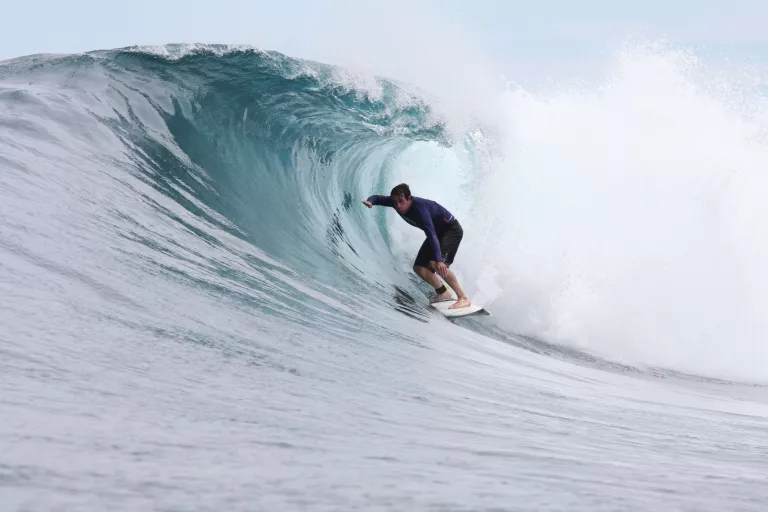
Miles Masterson, Surfing in Indonesia, 2011/Nick Aldridge
I met The Oom once, shortly before he died. We were five guys who’d been living in a van for two-and-a-half months, travelling in Namibia, so we were super-feral, and, heading down to Cape Town, we stopped in Elands Bay, where we spent four days waiting for a storm to pass, the wind to turn, the waves to come.
Sitting on the beach, we saw this Caravelle pull up, and this guy got out of the driver’s side, ran around to open the sliding door. First, we saw his passenger’s beard, then his head. The surf was crappy, all on shore, a mess, but as soon as his foot hit the sand, this perfect wave peeled down the point, just one. The passenger was The Oom, the first to surf here. The guy had something special about him.
We were the only people on the beach, and he sat and talked with us for two hours, and I literally can’t remember a word he said. I’d revered him as a god since I was a child.
I grew up on the Atlantic Seaboard in the ’80s, The Oom’s territory, and surfed the waves at places like Glen Beach, which he first surfed in 1954, and that was still the powerhouse of the sport in Cape Town in terms of the champions it produced. I was friendly with his youngest daughter, Sian. Glen Beach local Jeff Hancock made my first custom surfboards at The Oom’s nephew Johnny Paarman’s factory.
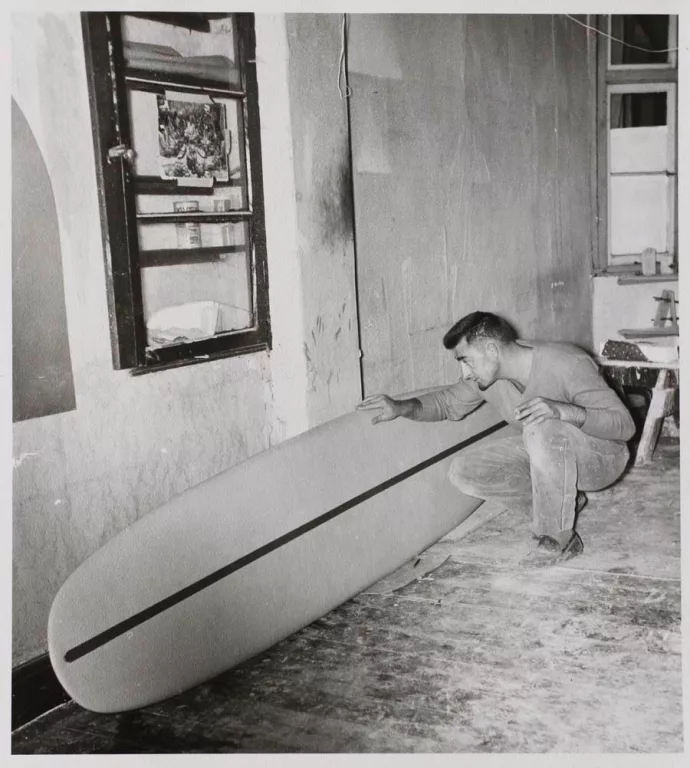
John in his first surfboard factory, Cape Town, early 1960s./OC Carstens
Seeing The Oom drive past, we were awe-struck. He was the stuff of myths and legends passed down from the older guys to us youngsters. Wherever I surfed, Sandy Bay, Llandudno, they were usually surfing spots he’d found first. His presence is everywhere.
I went travelling overseas for five years in 1992. Six months before my departure, I enrolled on a short course in journalism at Cape Technikon (now Cape Peninsula University of Technology). We spent the entire first evening writing. The instructor pulled me to one side and said, ‘You’ve got a career in this. Stick with it.’
While still on the course, I reported on a surfing contest for ZigZag magazine; however, I got my foot in the door as a surf journalist in the UK, the first stop on my adventure. I was down to my last £60, which I used most of to enter a surfing competition in Newquay, Cornwall, and made it to the quarter-finals, winning $400. I wrote about it from an insider’s perspective for Wavelength magazine, where I worked as an associate editor for the next four years.
By the time John passed away in 2001, I was a well-established writer. Later, in 2009, I had a book published, How to Surf. Rumour had it that a respected newspaper editor, the legendary Tony Heard, who’d grown up in Bakoven, thought it a good idea to write John’s biography. My first thought was that there must’ve been more to his story than I knew, beyond him being the founder of beach culture in South Africa.
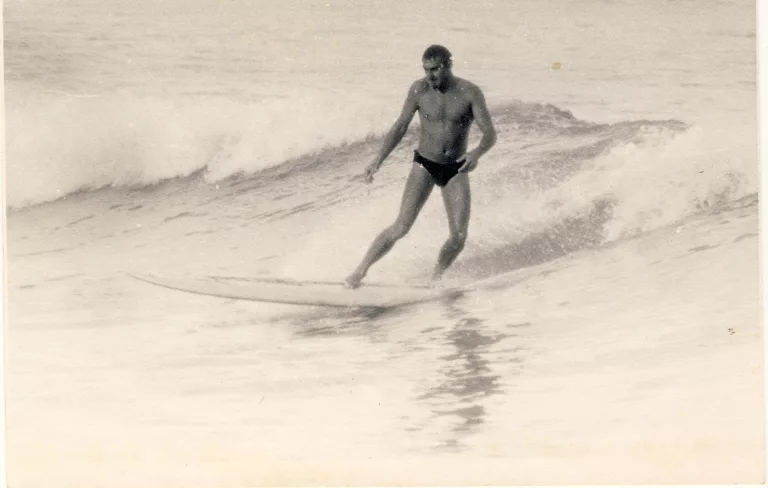
John surfing at Muizenberg, late 1950s. Photo © Gordon Verhoef
Little had been written about John, not all of it accurate. His family knew me well, personally and as a local surfer, and trusted me to pen his life story, including untold urban legends and his private persona.
Researching and writing John’s biography was a decade-long undertaking. I scoured the archives at the National Library and found copies of the magazine Outdoor Life, published in South Africa from 1962 to 1965, in which he’d written articles. One of his relatives gave me a family tree and an old photo of his parents, which I pieced together with ancestral records, even his father’s birth certificate.
John’s grandfather and great-grandfather were salesmen, but he didn’t have any of their influence growing up because his parents split when he was young. It was almost as if being a businessman was part of his DNA.
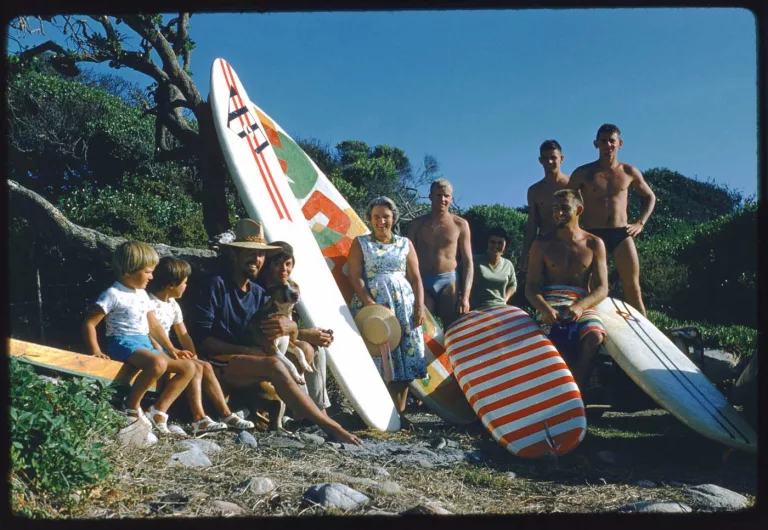
Whitmore family and friends Inner Kom Kommetjie Cape Town 1960./Dick Metz/SHACC
Conducting over 120 interviews offered insights into what John was really like. Patty, his sister-in-law, described him as quirky, genial, kind-hearted and warm. At times, he could be stubborn – you’d have to be to accomplish as much as he did, though sometimes, it would work against him, and he had some odd quirks, but was widely respected and loved.
He always had to be doing something, which meant he accomplished so much simultaneously – diving, discovering surfing spots, making surfboards, selling cars, playing a crucial role in the success of Bruce Brown’s iconic surf film, The Endless Summer. This made it challenging to tell his story chronologically, let alone weave his personal life into his sporting and business achievements. Walking in Tokai Forest with my kids, I bumped into the book’s eventual Developmental and Copy Editor, Steve Pike, who suggested I split the chapters into themes. The penny dropped.
Perseverance is a character strength of John’s that I admire. The proof is in the pudding. Guys still take to the waves on 60-year-old Whitmore surfboards. The shape, the design, the finish, the materials… they’re like Rolls Royces. I wanted to give up several times when writing this book. I had two young sons and a demanding job as the editor of a business magazine in Qatar. I’d ask myself, what would The Oom do? He’d see it through, so that’s what I did. I was also motivated by the fact that, to date, there has never been a book that documented South Africa’s contribution to world surfing, which all started with The Oom.
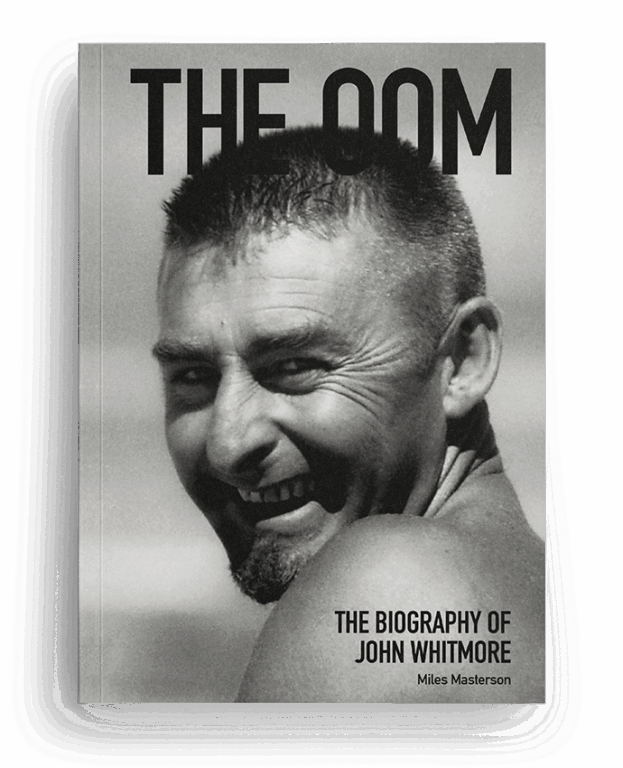
Also available as an e-book on Amazon Kindle (amazon.co.uk), Kobo and other e-book platforms (books2read.com). A percentage of all book sales goes to the South African Environmental NPO protectthewestcoast.org.
Words by Lisa Abdellah. Extracted from Getaway Dec25/Jan26
Follow us on social media for more travel news, inspiration, and guides. You can also tag us to be featured.
Instagram | Facebook | Twitter | Spotify
ALSO READ: