






A striking new monkey species with vivid pinkish-orange lips and jet-black fur has been officially recognised by scientists after years of eluding researchers in the dense rainforests of the Democratic Republic of Congo (DRC), as reported by the BBC.
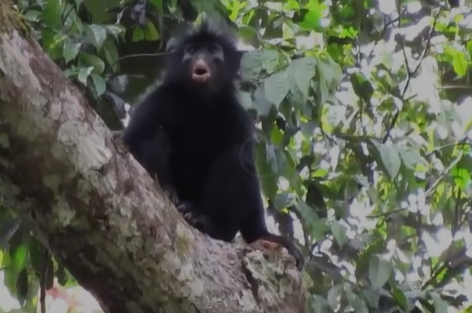
Screenshot from BBC video
Known locally as the Likweli, the primate was confirmed as a distinct species following years of fieldwork in Lomami National Park, making it only the fifth new African monkey species to be described in the past 75 years.
The findings were published in the scientific journal PLOS One.
A discovery years in the making
Conservationists first caught sight of the elusive monkey in 2008 while working in Lomami National Park, but only managed to capture a single blurry photograph. A second sighting a decade later prompted an international team of researchers from the DRC, the United States and Germany to investigate further.
Using photography, audio recordings and genetic analysis, the team confirmed that the monkey represents a previously unknown species. It has been given the scientific name Colobus congoensis, honouring the remarkable biodiversity of the DRC.
While the species is new to science, it was never entirely unknown. Local communities living near the forest have long recognised the monkey and refer to it as the Likweli.
ALSO READ:
Hidden high above the forest floor
One reason the monkey remained undocumented for so long is its secretive nature.
Researchers say the primates spend most of their lives high in the rainforest canopy, making them exceptionally difficult to observe.
“As part of our search, we interviewed people in 52 villages close to where the animals live, and only people in eight villages had ever seen them,” lead researcher Junior Amboko, a PhD student at Florida Atlantic University, told the BBC.
The monkeys are also known for their distinctive roaring calls, which are often heard echoing through the forest long before the animals themselves come into view.
An important role in the rainforest
The new species belongs to the colobus monkey family, a group of leaf-eating primates that lack thumbs and spend most of their time in the treetops.
Scientists believe these monkeys play a vital role in maintaining healthy forests by dispersing seeds and supporting natural regeneration.
Their eye-catching facial markings may also serve an important purpose, helping individuals recognise one another or attracting potential mates, although researchers say more study is needed to understand their behaviour.
Conservation concerns
Researchers believe Colobus congoensis has a limited range within the forests of central-eastern DRC and may already be under threat.
Like many forest mammals in the region, the monkeys are hunted for bushmeat, raising concerns about their long-term survival.
Now that the species has been formally described, conservationists hope it can receive greater legal protection while further surveys are carried out to estimate its population and better understand its ecology.
For now, the Likweli remains one of Africa’s most elusive primates—a reminder that even today, the continent’s rainforests continue to hold remarkable wildlife discoveries waiting to be uncovered.
Follow us on social media for more travel news, inspiration, and guides. You can also tag us to be featured.
Instagram | Facebook | Twitter | Spotify
ALSO READ:
Brazil adds Amazon river turtle to endangered species list for the first time