



Across the continent, wildlife has found ways to survive in some of the planet’s harshest environments. There are animals navigating deserts where water is scarce, predators living thousands of metres above sea level, birds gathering on salt pans that can become hostile wastelands, and forest specialists disappearing into dense tropical vegetation.
Some of these species have adapted over thousands of years to extreme temperatures, limited food and water, high altitudes or rapidly changing landscapes. Others are increasingly finding that the environments they depend on are changing faster than they can adapt.
From Namibia’s deserts to Ethiopia’s mountains and the rainforests of the Democratic Republic of Congo, these are some of Africa’s most extraordinary survivors.
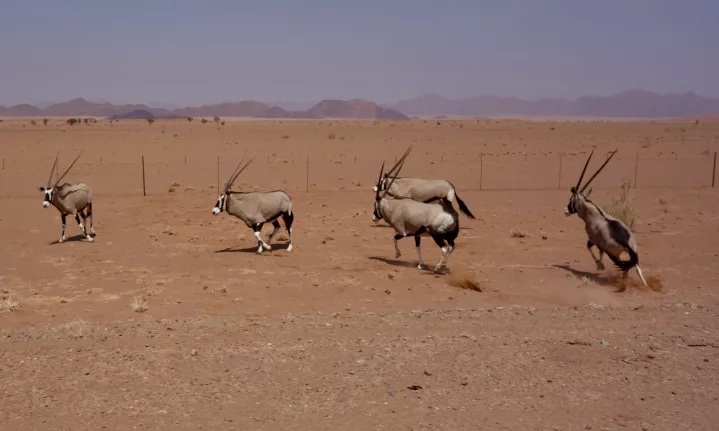
Oryx in the Namib Desert
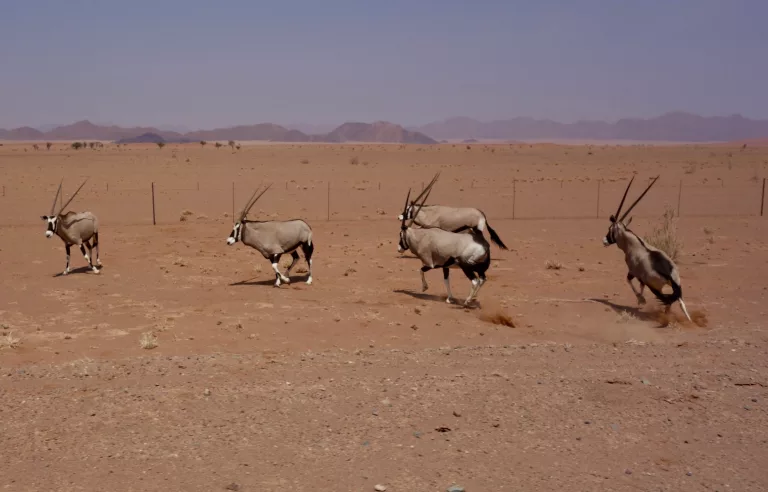
Oryxes in Namib Desert/Sonse/Wikimedia Commons
Built for one of Africa’s driest landscapes
The Namib is not the sort of place that immediately looks capable of supporting large mammals. Stretching along Namibia’s Atlantic coast, the desert is characterised by vast dunes, gravel plains and extremely limited rainfall.
Yet the gemsbok, or oryx, moves through this seemingly barren landscape with remarkable ease.
Its survival is less about finding a permanent water source and more about being exceptionally efficient with what the desert provides. Oryx can obtain moisture from vegetation and are adapted to cope with high temperatures and prolonged periods without drinking.
Their long, straight horns are useful for defence, while their pale bodies reflect some of the intense desert heat. Their behaviour also helps them cope with temperatures that would make activity dangerous for many other large mammals.
The result is an animal that looks almost perfectly designed for the desert.
The Namib is also a reminder that an environment does not need to be lush to support spectacular wildlife. Here, survival is about efficiency.
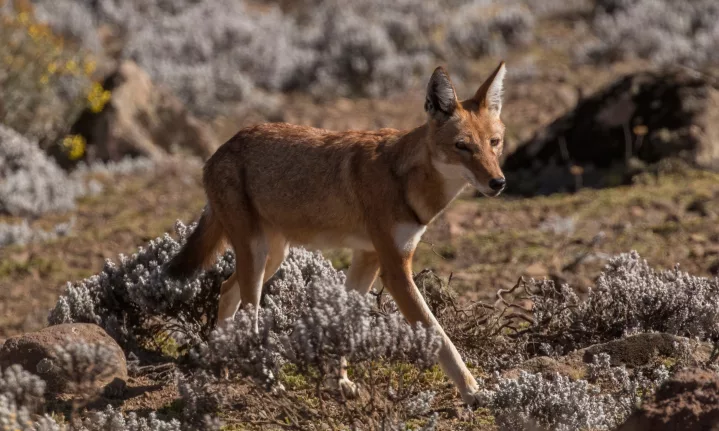
Ethiopian wolves in the highlands
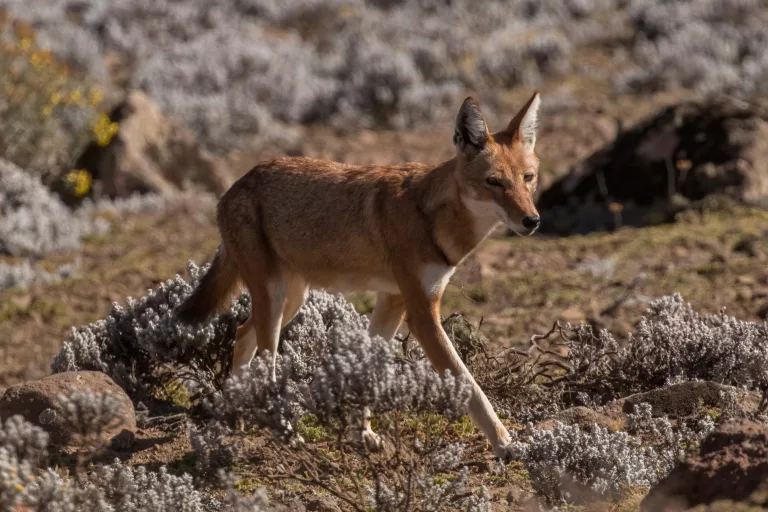
Ethiopian wolf in Sanetti Plateau, Ethiopia/Charles J. Sharp/Wikimedia Commons
Africa’s predator that lives above the tree line
Africa’s wildlife doesn’t always live in hot, low-lying landscapes.
In Ethiopia, the Ethiopian wolf occupies an extraordinary world of Afro-alpine grasslands and heathlands, generally between about 3,000 and 4,500 metres above sea level. The species is endemic to the Ethiopian highlands and has its largest remaining population in the Bale Mountains.
At these elevations, the landscape can feel more like the highlands of another continent than the Africa of safari brochures.
Temperatures are cooler, vegetation is sparse, and the air contains less oxygen. The wolves have become highly specialised predators of this environment, feeding largely on Afro-alpine rodents, including the giant molerat. Scientific research has also identified genetic signals associated with adaptation to the high-altitude environment.
A predator with nowhere else to go
The Ethiopian wolf’s remarkable adaptation comes with a major vulnerability: it cannot simply move to another habitat.
The species is confined to isolated highland populations, while agriculture, livestock grazing and habitat degradation increasingly put pressure on the areas it needs. The Ethiopian Wolf Conservation Programme estimates that fewer than 500 adults remain, making it the world’s rarest canid.
That makes protecting the highlands about more than preserving a beautiful landscape. It is about keeping an entire ecosystem alive for a predator that has evolved to live almost nowhere else.
ALSO READ:
72 hours in the Great Kei: Rivers, beaches and Xhosa country
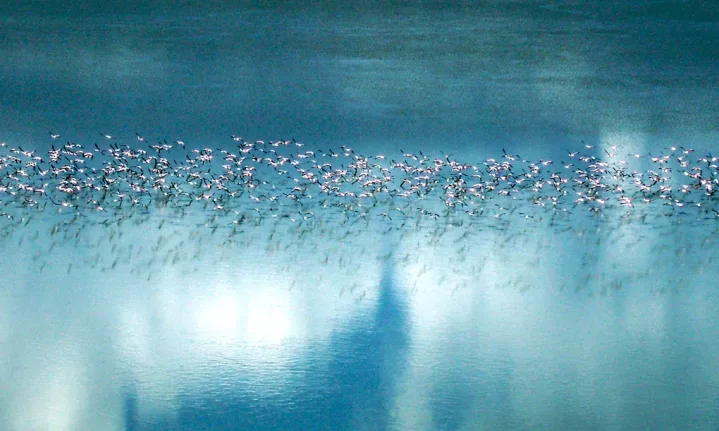
Flamingos on Africa’s salt pans
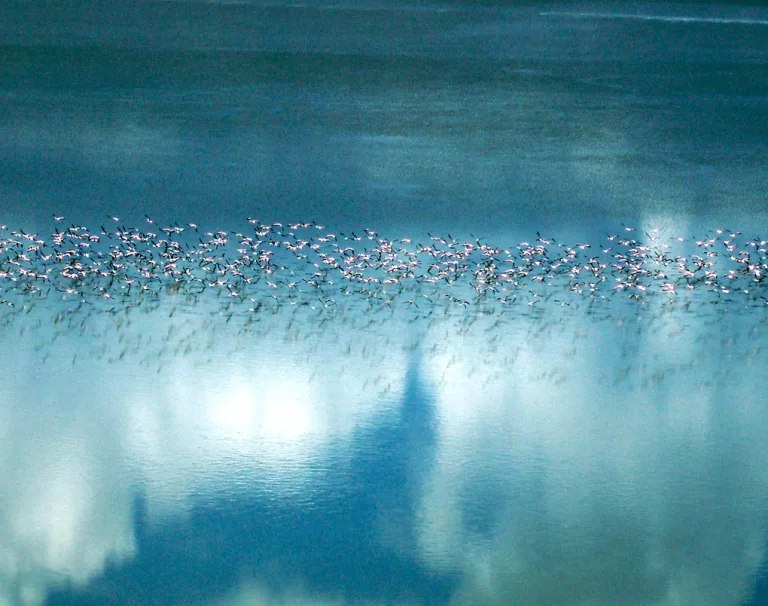
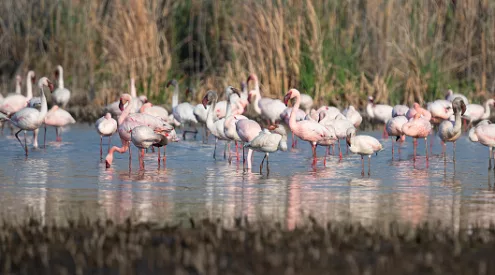
Flamingo migration in Makgadikgadi Pan/ed glickman from edina, usa/Wikimedia Commons
When a desert suddenly becomes a wetland
Few landscapes demonstrate Africa’s extremes quite as dramatically as its salt pans.
Botswana’s Makgadikgadi Pans can appear almost completely lifeless during dry periods. Vast expanses of salt and cracked earth stretch towards the horizon, creating an environment that seems hostile to almost everything.
Then the rains arrive.
Water temporarily transforms parts of the pans into shallow wetlands, creating feeding and breeding opportunities for enormous numbers of birds. Flamingos are among the most spectacular visitors, turning the stark landscape into a sea of pink.
The remarkable thing is that the birds aren’t simply surviving despite the extreme conditions. They are dependent on the cycle.
The temporary nature of the wetlands is part of what makes these landscapes so important. The same place can shift from an apparently barren salt desert to a productive wetland within a relatively short period.
Life on the edge of water and salt
Flamingos are particularly well suited to shallow, saline and alkaline environments that would be unsuitable for many other birds.
Their specialised bills allow them to filter tiny organisms from the water, while their long legs enable them to wade through shallow wetlands.
The spectacle is therefore about much more than thousands of birds gathering together. It is a story about timing, rainfall and an ecosystem that exists in dramatically different forms throughout the year.
Mountain gorillas in volcanic forests
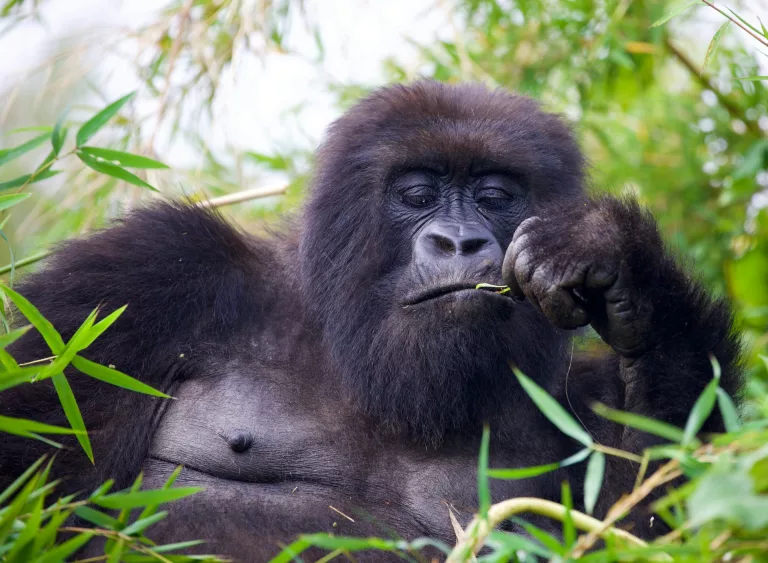
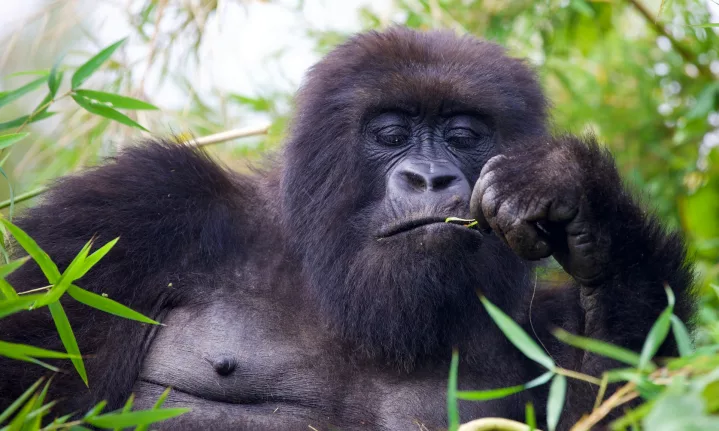
Mountain gorilla in Rwanda/Magdalena Kula Manchee/Unsplash
Where mountains, volcanoes and rainforest meet
The Virunga mountains offer another definition of an extreme environment.
This volcanic mountain chain stretches across Rwanda, Uganda and the Democratic Republic of Congo, with dense montane forests climbing the slopes of a landscape shaped by volcanic activity.
Some of Africa’s most famous wildlife lives here: the mountain gorilla.
The world’s remaining mountain gorillas occur in the Virunga Massif and Bwindi forest, with Virunga National Park protecting more than a third of the global population.
Unlike desert specialists, mountain gorillas don’t have to cope with a landscape devoid of food. Instead, they navigate steep slopes, cool temperatures and dense vegetation at high elevations.
Their lives are closely tied to the mountain forest.
They feed extensively on vegetation, moving through bamboo forests and montane vegetation in search of food. Their large size and powerful build make sense in a habitat where travelling through dense vegetation and climbing steep terrain is part of everyday life.
An extreme landscape with an extraordinary payoff
For travellers, seeing mountain gorillas means entering a world very different from the classic African savannah.
No wide game-drive tracks are stretching across open grasslands. Instead, the experience is about walking through misty forest, following trails and paying attention to signs of a family moving through the vegetation.
The landscape may be challenging, but it has created one of Africa’s most extraordinary wildlife experiences.
Okapi in the Congo rainforest
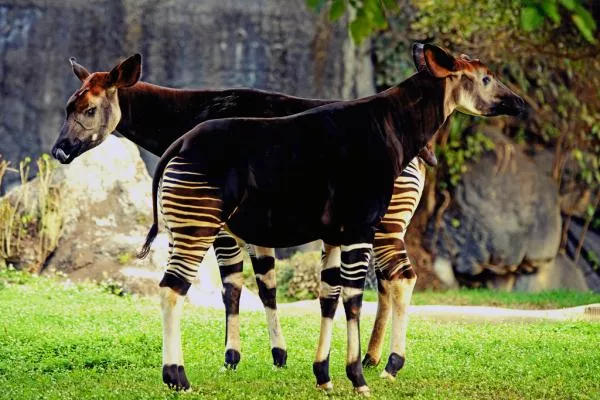
Okapi in Congo/Grace Tshiyonga/Wikimedia Commons
A forest so dense that even a giraffe relative disappears into it
Deep in the Democratic Republic of Congo’s Ituri Forest lives one of Africa’s strangest mammals.
The okapi is sometimes called the “forest giraffe”, and it is closely related to the giraffe. Yet seeing one in the wild is a very different experience from spotting its taller relative on an open savannah.
Okapis are shy, solitary animals found only in the rainforests of the DRC. Their distinctive striped legs and rump help make them instantly recognisable, although the dense forest makes them remarkably difficult to find.
The Ituri Forest is itself an extreme environment in a completely different sense.
There are no sweeping views here. Visibility can be limited by layers of vegetation, while humidity, rainfall and the sheer density of the forest create a challenging environment for both people and wildlife.
The okapi has adapted to this world by becoming a specialist forest browser, feeding on leaves and vegetation from numerous plant species.
Protecting the animal means protecting the forest
The Okapi Wildlife Reserve lies at the heart of the Ituri Forest and was recognised as a UNESCO World Heritage Site in 1996. The reserve protects not only okapi but a remarkably diverse ecosystem that includes forest elephants, chimpanzees, leopards and numerous other species.
The okapi therefore represents something bigger than one unusual mammal.
Protecting it means protecting one of Africa’s great remaining rainforests.
Meerkats in the Kalahari
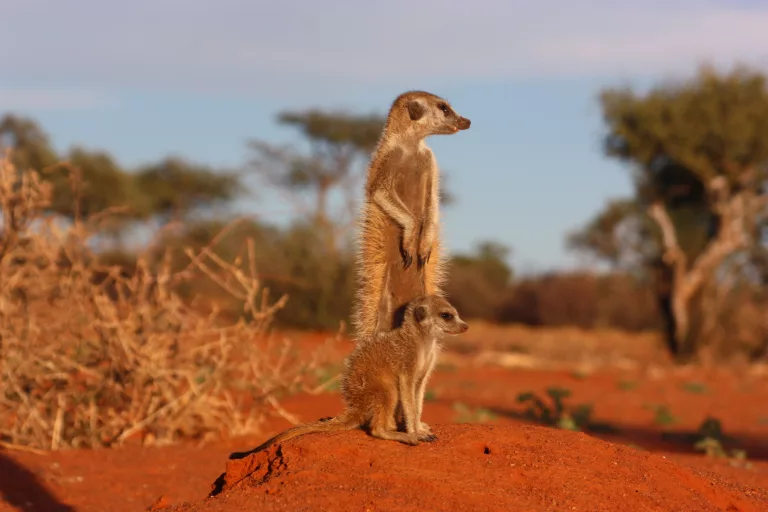
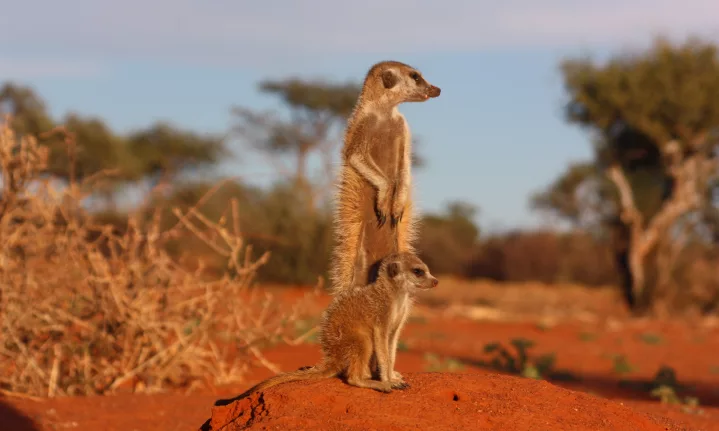
Meerkat and pup. First light in the Kalahari desert/Charles J. Sharp/Wikimedia Commons
Small animals with big desert adaptations
The meerkat might be one of the most familiar animals on this list, but its lifestyle is no less remarkable.
In the Kalahari, these small mongooses live in an environment defined by heat, dryness and dramatic temperature swings.
Much of their lives revolves around their burrows. Underground shelters protect them from predators and help them escape the worst of the daytime heat and nighttime cold.
Their behaviour is just as important as their physical adaptations.
Meerkats forage together, with members of the group often taking turns keeping watch while others search for food. Their upright stance, so familiar from wildlife documentaries, is therefore more than an iconic pose: it is part of a highly social survival strategy.
The desert is a team effort
For meerkats, surviving an extreme environment is not simply an individual challenge.
Their social structure gives the group advantages when searching for food, raising young and detecting predators.
It is a useful reminder that adaptation isn’t always about claws, thick fur or specialised anatomy. Sometimes the most important survival strategy is cooperation.
African penguins along the Southern African coast
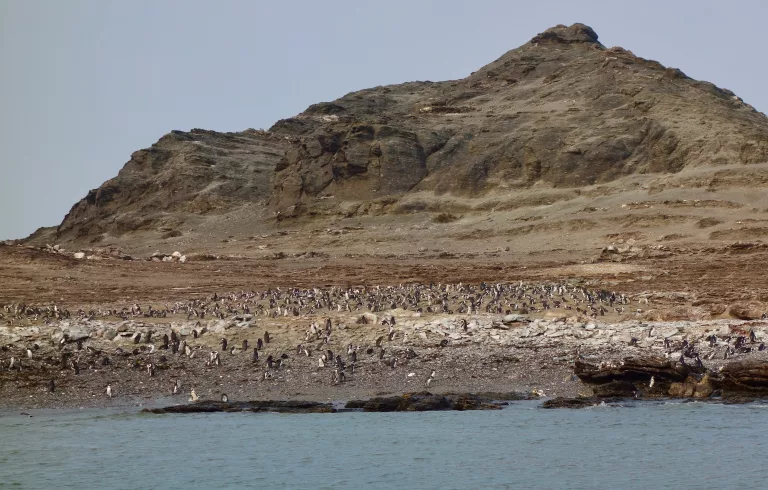
Penguins at Halifax Island /Sonse/Wikimedia Commons
A penguin in Africa’s waters
Perhaps the most surprising animal on this list is the African penguin.
There are no Antarctic ice sheets here. Instead, these penguins live along the coastlines of South Africa and Namibia, where they forage in cold, nutrient-rich marine waters.
They are the only penguin species that breeds on the African mainland, with colonies stretching from Namibia through South Africa.
Their environment is extreme in a different way. Rather than coping with desert heat or thin mountain air, African penguins are dependent on a productive but increasingly pressured marine ecosystem.
They are excellent swimmers and can dive to considerable depths while hunting for small pelagic fish. Their feathers provide both insulation and waterproofing, allowing them to move between land and cold seawater.
One of Africa’s most vulnerable survivors
The African penguin also provides the clearest warning in this story.
The species was uplisted to Critically Endangered globally in 2024, and South Africa had fewer than 9,000 breeding pairs remaining in 2025. Major pressures include food availability, climate change, fishing, oil spills and maritime disturbance.
There have, however, been important conservation developments.
In 2025, a court-ordered settlement established fishing restrictions around key penguin colonies, with measures intended to improve access to important prey species such as sardine and anchovy.
The penguin’s story brings the wider theme of the article into focus: being perfectly adapted to an extreme environment doesn’t necessarily protect a species when that environment itself is changing.
Africa’s extreme landscapes are wildlife habitats
From the dunes of the Namib to the Afro-alpine plateaus of Ethiopia, Africa’s wildlife has found ways to survive in places where conditions appear almost impossible.
An oryx can cross a desert. An Ethiopian wolf can hunt above 4,000 metres. Flamingos can turn temporary salt-pan wetlands into breeding grounds. Mountain gorillas inhabit volcanic forests, while okapis disappear into one of the world’s great rainforests. Even the African penguin has made a life in the cold waters at the southern edge of the continent.
These animals demonstrate that Africa’s wildlife story extends far beyond savannahs and safari vehicles.
And in many of these places, protecting the animal means protecting the extreme environment that made its survival possible in the first place.
Follow us on social media for more travel news, inspiration, and guides. You can also tag us to be featured.
Instagram | Facebook | Twitter
ALSO READ:


.jpg)
.jpg)


