

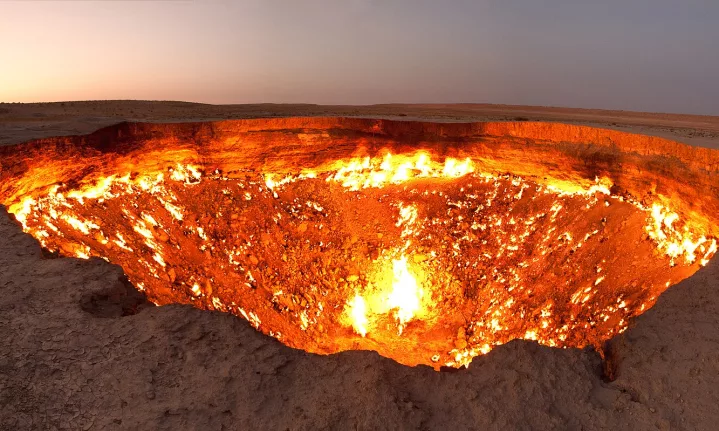
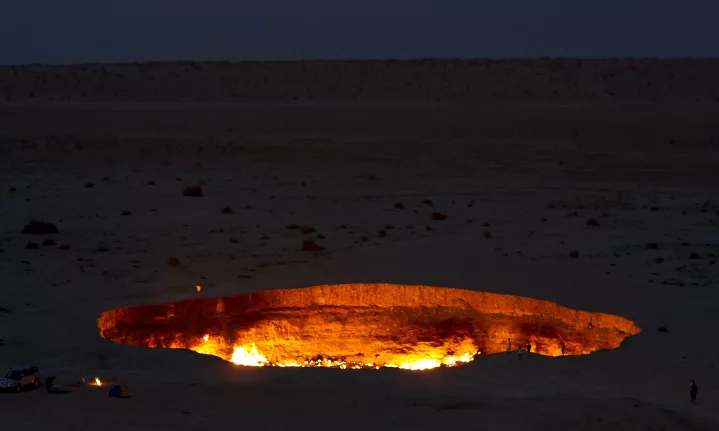
For more than five decades, a giant crater has burned in the middle of Turkmenistan’s Karakum Desert. Now, the flames that made the Door to Hell famous are beginning to fade.
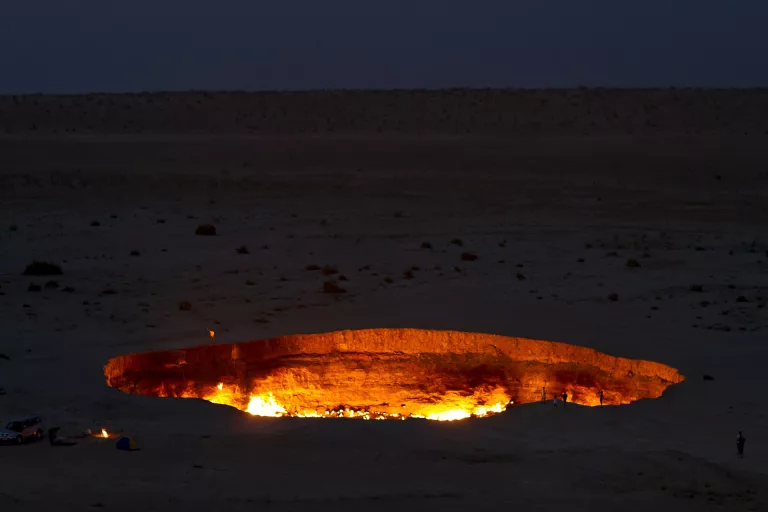
Door to Hell, Gates of Hell, Derweze, Turkmenistan, a gas crater burning since 1971, glowing in the night / Benjamin Goetzinger / Wikimedia Commons
By day, the Darvaza gas crater looks almost otherworldly. A vast depression cuts into the desert, surrounded by sand, scrub and open sky.
After dark, this world transforms dramatically. Orange flames flicker across the crater floor, casting an eerie glow over the surrounding desert and giving the site its infamous nickname: the Door to Hell.
But the fire is no longer what it once was. In recent years, the flames have weakened as Turkmenistan works to reduce the natural gas feeding the crater. In 2025, visitors reported seeing only isolated areas of fire where a much larger blaze once burned. The state gas company, Turkmengaz, has been drilling and reopening wells around the site to capture gas that would otherwise reach the crater.
For one of the world’s strangest travel sights, the end may be approaching.
How the fire began
The story of Darvaza is almost as unusual as the crater itself, although some details remain disputed.
The commonly accepted account dates its creation to 1971, when Soviet geologists were searching for natural gas in the Karakum Desert. The ground reportedly collapsed beneath their drilling equipment, opening an underground cavern and releasing gas.
Engineers are said to have ignited it, expecting the gas to burn out within days. It did not.
NASA identifies the crater as the result of a Soviet drilling operation that encountered an underground cavern. However, explorer George Kourounis was told during his 2013 expedition that the collapse may have happened earlier and that the gas might only have been ignited years later. Surviving records have not definitively settled the timeline.
What is certain though, is that methane escaping from the gas-rich region beneath the desert has sustained the flames for decades. The crater is roughly 60 to 70 metres across and about 30 metres deep, although measurements differ.
From the rim, it looks less like an industrial accident and more like something from another world.
Inside the Door to Hell
Darvaza became even more famous in 2013, when explorer George Kourounis descended into the crater.
The expedition took two years to prepare. Kourounis entered wearing specialised heat-resistant equipment and a breathing apparatus, collecting soil and gas samples from the crater floor while surrounded by flames. The team was also investigating whether microorganisms could survive in such extreme conditions.
He spent about 17 minutes inside before being brought back to the surface. For most travellers, the view from above is more than enough.
At night, the surrounding Karakum disappears into darkness, leaving the crater glowing against the desert.
Why the flames are fading
The spectacle is also the visible result of an uncontrolled gas leak.
Turkmenistan has been working to reduce the methane reaching the crater by drilling new wells and reopening existing ones to extract gas from the surrounding field. Government authorities say these measures have significantly reduced the flow feeding Darvaza.
There is an environmental reason for doing so. Methane is a potent greenhouse gas, meaning simply extinguishing the flames without controlling the gas beneath them would not necessarily solve the problem. Capturing the gas instead prevents it from escaping directly into the atmosphere.
Turkmengaz has announced further drilling intended to divert gas away from the crater and ultimately eliminate the uncontrolled emissions. The Door to Hell, in other words, may not end with a dramatic extinguishing. It’s fire could simply become smaller and quieter as the gas supply is reduced.
A disappearing desert landmark
Darvaza has become one of Turkmenistan’s most recognisable sights, despite the country’s tightly controlled tourism environment.
It’s remoteness is part of its appeal. Hundreds of kilometres from Ashgabat, the crater sits alone in the Karakum, with little around it but desert. That makes the changing flames all the more significant.
Turkmenistan has recently taken steps towards attracting more international visitors, including introducing electronic visas and removing the previous requirement for a formal invitation letter, although travel remains controlled. The timing is almost ironic: as access begins to open, one of the country’s most famous attractions is losing the spectacle that put it on the map.
Before the fire goes out
There is something strangely fitting about Darvaza fading back into the desert. The crater was never intended to become a landmark. It was created during a search for natural gas, turned into an uncontrolled fire and eventually transformed into one of the world’s most unusual travel destinations.
For more than 50 years, travellers have crossed the Karakum to stand at its edge and watch the flames below. Now, the fire is becoming quieter.
The crater will remain, even if the flames eventually disappear. So will the story of the Soviet drilling operation, the mystery surrounding its exact origins and the travellers who came to see a burning hole in the middle of nowhere. The Door to Hell may be closing. But for now, there is still fire in the desert.
Follow us on social media for more travel news, inspiration, and guides. You can also tag us to be featured.
Instagram | Facebook | Twitter | Spotify
ALSO READ: