




At Stony Point in Betty’s Bay, African penguins and small-scale fishers share more than a stretch of coastline. Both depend on a healthy ocean, and as fish stocks decline and the penguin population edges closer to extinction, local fishing communities are finding new ways to help protect the sea they have called home for generations.
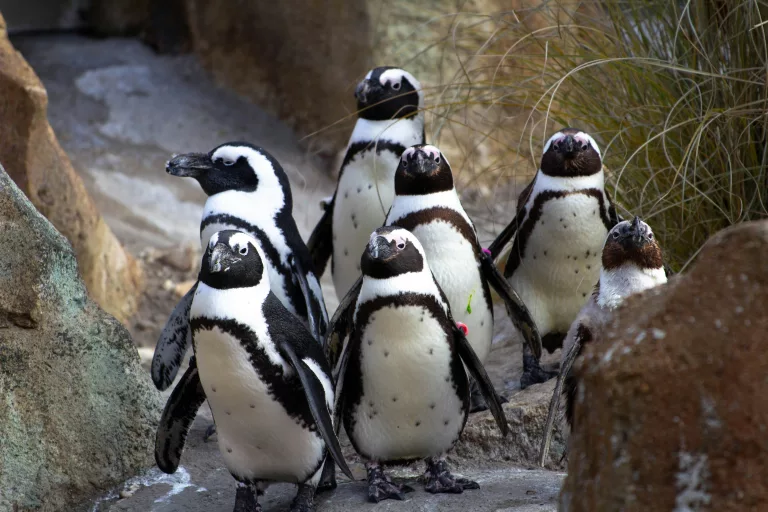
Photo: Unsplash
Seventy-four-year-old Aunty Miriam Smit has lived in Kleinmond since she was nine, when she moved there with her family from a farm in the Overberg. They lived in a close-knit community at the harbour.
‘Life there was wonderful,’ she tells tourists. ‘The fishermen would go out on the water at 4 am, and if we were awake, my father would say, “Let’s go and help them get their boats into the sea.”’
Miriam was 14 when apartheid-era forced removals tore the community apart. One summer’s day, the municipality arrived with tractors, bulldozers and lorries, ordering residents to pack their belongings and leave the harbour before their homes were reduced to rubble.
Many people living in the Kogelberg area are descendants of a fishing community established by the mid-1800s. They traditionally fish from the shore or small boats, using methods passed down through generations.
Marcelin Barry, 28, grew up in Kleinmond and remembers standing on the harbour with the women in his family, waiting for the men to return from a day at sea.
‘They’d give us the little fish they caught, and we’d take them to our grandmother and she’d bake Cape bream, Hottentot, as we call it. There were so many fish, especially during snoek season.’
Today, there are significantly fewer line fish species around Stony Point. There hasn’t been any snoek there for at least seven years, forcing fishers to travel to the West Coast to find it.
What these fishers know about the ocean can’t be learnt from a book. Local fisher Morne Yon, 47, describes the sea as ‘a living force, to be respected, never taken for granted’.
To the sea
A major attraction in the Kogelberg is Stony Point in Betty’s Bay, home to a unique colony of African penguins and four species of cormorant. Hartlaub’s and kelp gulls also forage around the colony, while rock hyraxes and southern rock agamas can often be spotted basking on the rocks.
CapeNature manages the colony, with assistance from SANCCOB, BirdLife South Africa and WWF South Africa. The site has wooden walkways for visitors, while plans include improved wheelchair access and greater coastal access for penguins, as well as shade structures to protect them from the summer heat.
But the African penguins themselves are in serious trouble.
In 2024, the IUCN listed African penguins as Critically Endangered and predicted their extinction in the wild by 2035. At Stony Point, only 676 breeding pairs were counted, almost half the number recorded the previous year.
Historical threats include egg collection, predation, climate change, oil and noise pollution and habitat loss. But one of the biggest problems is food.
African penguins are specialist feeders, relying heavily on sardines and anchovies. When these small pelagic fish become scarce, the penguins cannot simply switch to another food source. Research has shown that competition with large-scale purse-seine fisheries can reduce the fish available to penguin colonies.
Conservation groups SANCCOB and BirdLife South Africa, represented by the Biodiversity Law Centre, took legal action against the South African government, arguing that existing fishing closures were not enough to prevent the African penguin’s extinction.
In March, the government, environmental groups and the fishing industry agreed to new no-fishing zones around penguin breeding colonies. Stony Point was one of five colonies to benefit, with the exclusion of small pelagic purse-seine fishing covering more than 90% of the colony’s core foraging area.
The research continues. Weighbridges at four colonies, including Stony Point, record penguins’ weight before and after foraging, helping researchers assess whether the new closures are working.
But conservationists say more needs to be done outside the breeding season, when young penguins leave protected areas and need sufficient fish stocks throughout their different life stages.
Back to land
Saving the African penguin is about more than conservation. For small-scale fishers, the decline of these birds is also a warning about the health of the broader marine ecosystem.
Penguins rely on sardines and anchovies, which are also an important food source for sought-after line fish such as geelbek. Protecting the penguins’ food supply can therefore benefit the wider marine ecosystem – and the fishing communities that depend on it.
But coastal communities are among the most marginalised groups in South Africa, says Craig Smith, a senior marine specialist at WWF. They often have little voice in government and science.
In 2013, WWF established an office in Kleinmond to pilot its Fisheries Conservation Project with local fishers and the wider community. Rather than pushing fishers towards completely different careers, the project looked for livelihoods connected to the ocean, including marine ecotourism.
The Mooi Uitsig community, for example, has commercial rights to run On the Edge Restaurant, with its success closely linked to the penguin colony and the tourism it attracts.
Another success story is Relebohile Mbhele, who heads the guides at Sisonke Enviro Tours. After moving to Kleinmond in 2018, she joined a WWF-supported training programme that helped five Kogelberg community members qualify as ecotourism guides.
The guides now conduct nature-based tours, sharing the Kogelberg’s natural and cultural heritage while earning an income.
WWF has also helped local fishers with catch monitoring and access to markets. Apps such as ABALOBI Fisher and ABALOBI Marketplace allow fishers to record their catches and sell WWF-SASSI Green-listed species to restaurants.
In 2023, two small-scale fishing co-operatives in the Kogelberg received fishing rights for the first time.
Then there are the community members working directly in conservation.
Marcelin was one of 19 local people recruited by WWF as a Marine and Coastal Community Monitor. Two of the positions at Stony Point are funded by WWF. The monitors record environmental concerns, count seabirds and mammals, check for pollution and entanglements, and collect plastic waste from the shoreline.
Today, Marcelin works as a conservation monitor at WWF and Stony Point. He has been trained to handle birds injured by predators or pollution and to tube-feed chicks.
He has also contributed to research into South Africa’s smaller endemic shark species. Alongside other local fishers and community members, he helped scientists collect data using Baited Underwater Video Systems, or BRUVs, to study marine species and their habitats along the coast between Betty’s Bay, Pringle Bay, Kleinmond and Hermanus.
The project recorded 70 marine species, with findings showing that smaller endemic sharks, including pyjama and puffadder shysharks, were thriving in kelp and reef habitats. It also highlighted the importance of protecting sandy and muddy habitats used by other sharks and rays.
For Marcelin, the work has changed his relationship with the sea. During the project, he finally went out on a fishing boat himself, rather than watching the boats from shore.
Scientists can take years to understand why an environment behaves the way it does. Fishers have often learnt these patterns over decades – when fish gather, where they feed and how the seasons affect the sea.
The challenge now is bringing those two knowledge systems together.
WWF convenes quarterly meetings between stakeholders, community-based fishers, the Kogelberg Biosphere Marine Working Group and CapeNature to discuss everything from ocean governance and poaching to management and compliance.
It makes sense. Scientists, conservationists and fishers may come from very different backgrounds, but they share the same hope: a healthy ocean that can continue to support both people and wildlife.
And perhaps, ultimately, they all want the same thing – not to read about the extinction of the African penguin in 2035.
ALSO SEE: Nine African Penguins return to the wild in SANCCOB’s latest release
Nine African Penguins return to the wild in SANCCOB’s latest release
Written by Lisa Abdellah for Getaway August 2025.