



A devastating flash flood and landslide disaster near Nepal’s border with Tibet has killed at least 165 people, with more than 1,000 still missing as rescue teams search remote valleys and damaged communities.
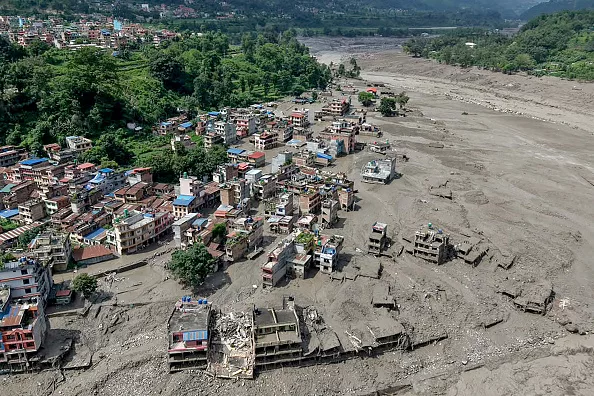
This aerial view shows houses laying partially submerged in muddy water along a riverside after flash floods at Trishuli Bazar in Nepal’s Nuwakot district on August 26, 2026. A massive flood swept through Nepal’s northern Rasuwa district on August 26, damaging roads and power infrastructure as authorities scrambled to assess the scale of the destruction. (Photo by Prabin RANABHAT / AFP via Getty Images)
The disaster struck on Wednesday, 26 August, when a massive surge of water, ice, rock and mud swept through the Lhende Khola river valley in northern Nepal. The river feeds into the Bhote Koshi and Trishuli systems, carrying floodwaters through several communities and popular travel routes.
People Magazine reported that at least 160 people had died by Wednesday, with more than 400 people initially listed as missing, including 341 foreign nationals. Among those reported missing were 47 Americans.
Since then, the reported figures have continued to rise as authorities gain access to affected areas. Reuters reported on Thursday that the death toll had reached at least 165, while nearly 1,500 people were reported missing across Nepal and Tibet.
A disaster initially mistaken for an earthquake
The flooding was initially linked by Nepali officials to an earthquake recorded in the region. Further analysis, however, indicated that the seismic activity was caused by a huge landslide and glacial collapse rather than a conventional earthquake.
Reuters reported that part of a Himalayan glacier collapsed at high altitude, sending ice and rock into the Lhende Khola. The debris temporarily blocked the river before the natural barrier gave way, releasing a destructive surge downstream. The US Geological Survey subsequently identified the seismic event as being caused by the landslide.
The sudden nature of the flood made the disaster particularly dangerous. Reports said flooding struck at around 8:40am local time, while affected communities had little warning of the wall of water, mud and debris moving through the valleys.
Foreign tourists and pilgrims among those missing
The disaster has also affected international travellers, with hundreds of foreign nationals reported missing in the aftermath of the flooding.
Many of those unaccounted for were travelling towards Mount Kailash in Tibet on religious pilgrimages, while others were trekking in Nepal’s Rasuwa district during the busy travel period. Al Jazeera reported that those reported missing included nationals from India, the United States, Australia, the United Kingdom, Canada and several other countries.
Four South Africans were also reported missing. Nepal’s tourism board said the four were travelling with Alpine Eco Trek, the same agency linked to 12 missing British nationals.
The figures remain preliminary as authorities continue to verify the whereabouts of people who were in, or travelling through, the affected areas when the floods struck. People Magazine reported that more than 400 people were initially listed as missing, including hundreds of foreign nationals.
The Nepal Tourism Board has been working with tourism operators, local authorities and security agencies to establish the whereabouts and safety of travellers affected by the disaster.
Rescue efforts face difficult conditions
Nepalese army personnel, police and emergency teams have been deployed alongside helicopters, drones and search dogs. Rescue operations have been hampered by destroyed roads, damaged bridges, high river levels and heavy layers of mud and debris.
Reuters reported that 125 people, including 20 foreign nationals, had been rescued by Thursday as emergency teams continued working in isolated areas.
The flooding also damaged key roads, hydropower infrastructure and communities along the route linking Nepal and Tibet, while authorities have warned of further dangers in areas where rivers remain blocked or unstable.
The United Nations has expressed concern over the scale of the destruction in Nepal and China, while international governments and humanitarian organisations have offered assistance.
The full scale of the disaster is still emerging, and both the death toll and number of missing people are expected to change as search and rescue teams reach more of the affected areas.
Follow us on social media for more travel news, inspiration, and guides. You can also tag us to be featured.
Instagram | Facebook | Twitter | Spotify
ALSO READ:
UKZN researchers use bird radar to study millions of swallows