
Game drives are one of the easiest ways to explore South Africa’s wildlife, but sometimes the best way to experience the bush is to leave the vehicle behind.
Walking slows everything down. Instead of covering kilometres in search of the Big Five, you start noticing tracks in the sand, birds calling from the trees, insects moving through the grass and the smaller details that are easily missed from a vehicle.
From guided walks in Big Five country to coastal trails where whales and seabirds become part of the experience, these are six South African wildlife experiences worth exploring on foot.
1. Kruger National Park, Limpopo and Mpumalanga
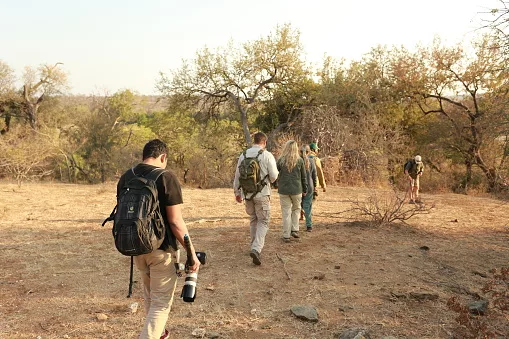
A tourist group walking in the Kruger National Park with an experienced guide/By: rudi_suardi/Getty Images
Get closer to the smaller details of the bush
Kruger is one of South Africa’s best-known safari destinations, but you don’t have to spend your entire visit in a game-viewing vehicle.
SANParks offers guided walks from several camps, with small groups accompanied by armed field guides. The walks generally last a few hours and take visitors into wilderness areas around the camps.
On foot, the focus shifts from ticking animals off a sightings list to understanding the landscape. Guides can point out tracks, plants, insects, birds and signs of larger animals that might otherwise go unnoticed. There is also the possibility of encountering larger game, which makes walking through the bush a very different experience from watching animals from a vehicle.
The walks are particularly rewarding for visitors who enjoy learning about the smaller workings of an ecosystem, rather than simply looking for the next big sighting.
Good for: First-time walking safari experiences and travellers who want to see the bush differently.
2. iMfolozi Wilderness, KwaZulu-Natal
Walk through some of South Africa’s oldest wilderness
The iMfolozi section of Hluhluwe-iMfolozi Park has a long association with walking safaris. Its wilderness trails offer a chance to experience Big Five country without the usual game-drive routine.
Multi-day wilderness trails take hikers deep into the reserve with experienced armed guides. The emphasis is not on racing between sightings, but on moving quietly through the landscape and learning to read the signs left behind by wildlife.
The experience can be particularly rewarding around rhino country, with iMfolozi’s conservation history closely linked to the protection of white rhinos. The area is also home to a wide variety of other wildlife and birdlife.
Walking here also gives travellers a better appreciation of just how much there is to notice between major animal sightings. A track, broken branch or fresh dung can tell a story before an animal ever comes into view.
Good for: Experienced hikers and travellers looking for a more immersive wilderness experience.
3. De Hoop Nature Reserve, Western Cape
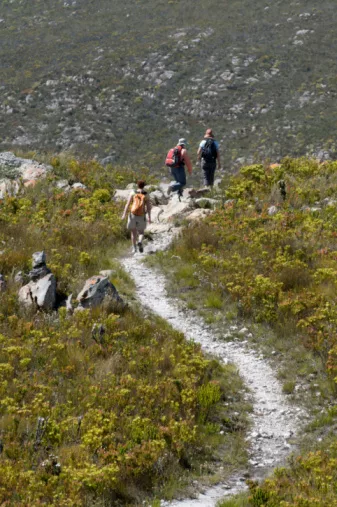
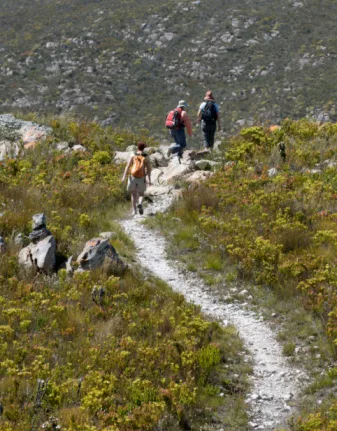
A path leads towards some hikers walking through fynbos, Whale Trail coastal hike/By: Shem Compion
Gallo Images ROOTS RF collection
Walk where fynbos meets the ocean
Wildlife experiences do not always have to involve elephants and lions. At De Hoop, walking brings together fynbos, mountains, coastline, birds and marine life.
The reserve has several hiking options, including the Klipspringer Trail and Coastal Trail. The latter begins at Koppie Alleen, a well-known whale-watching viewpoint, before following either the beach or rocky shoreline. Along the way, hikers can explore rock pools, limestone formations and coastal habitats.
For a longer adventure, the 55km Whale Trail crosses the reserve from Potberg to Koppie Alleen over five days. The route passes through fynbos and coastal landscapes, with southern right whales visible from the coastline during their breeding season.
De Hoop is also home to bontebok, Cape mountain zebra, eland, grey rhebok, baboons and smaller mammals, while the Potberg area supports the Western Cape’s remaining breeding colony of Cape vultures.
Good for: Coastal wildlife, birding, whale watching and travellers who prefer scenery as much as animal sightings.
ALSO READ:
5 South African towns that came close to becoming ghost towns
4. Pilanesberg National Park, North West
Discover what is happening beneath your feet
Pilanesberg is close enough to Johannesburg and Pretoria to make it a practical wildlife escape, but its walking experiences offer something quite different from a conventional game drive.
Guided walking safaris are led by qualified guides who introduce visitors to the park’s plants, birds, insects and mammals. Being on foot makes the immediate environment feel much more important. You may spend time examining tracks or learning about a particular plant before moving on, rather than simply driving past it.
The park’s walking experiences can also introduce visitors to the smaller members of the ecosystem, while there is always the excitement of knowing that larger wildlife may be nearby.
For families, Pilanesberg also offers a separate family bush walk in the Letsatsing Game Park, designed for visitors with children under 16.
Good for: A more accessible walking experience and travellers looking for a wildlife outing within easy reach of Gauteng.
5. Addo Elephant National Park, Eastern Cape
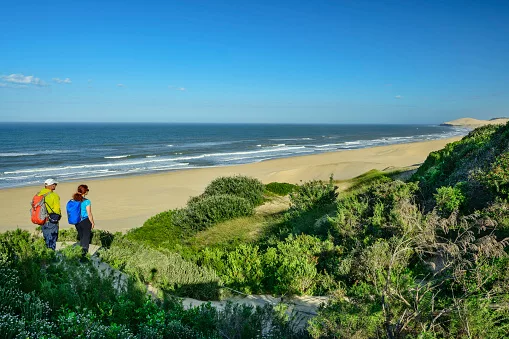
Man and woman hiking Alexandria Trail at Addo Elephant National Park/By: Westend61/Getty Images
Swap the safari vehicle for a forest and coastal trail
Addo is synonymous with elephants, but some of its most interesting walking experiences take visitors away from the traditional game-viewing landscape.
The park’s Alexandria Hiking Trail is a 36km circular route through forest, coastal dunes and shoreline. The two-day route requires a moderate to good level of fitness, particularly for the dune crossing, while the shorter Tree Dassie Trail offers a less strenuous introduction to the Woody Cape forest.
There are also trails in the Zuurberg section of the park, where hikers can encounter species such as mountain reedbuck, red hartebeest, bushbuck, monkeys, baboons and dassies, as well as a variety of birds.
The Cannon Trail adds another dimension, passing through coastal forest before reaching the beach. Birders can look for species such as the Knysna turaco and African black oystercatcher, while seals, dolphins and whales may be spotted from the coast.
Good for: Hikers who want wildlife, forests and coastline in one experience.
6. iSimangaliso Wetland Park, KwaZulu-Natal
Slow down for birds, butterflies and wetland wildlife
The wildlife experience at iSimangaliso is not limited to big mammals. Its wetlands, forests, lakes and coastline support an extraordinary variety of smaller wildlife, making it particularly rewarding to explore slowly on foot.
At False Bay, on the western shores of Lake St Lucia, visitors can choose between several self-guided walking trails. The shorter Mpophomeni Trail passes through sand forest and woodland, while the longer Ingwe and Dukandlovu trails offer opportunities to see species such as nyala, duiker and bushbuck.
The area is also rich in birdlife and butterflies. Along the trails, visitors can listen for forest birds, look for colourful butterflies and watch the lake edge for wildlife. The longer Dukandlovu Trail combines forest and lakeshore habitats, where hippos, crocodiles and waterbirds may be seen.
iSimangaliso also offers guided walks elsewhere in the park, making it a good choice for travellers who want to experience a wetland ecosystem at a slower pace.
Good for: Birders, nature lovers, families and anyone more interested in the full ecosystem than a Big Five checklist.
Why wildlife looks different on foot
A walking safari does not necessarily mean seeing more animals. In fact, you may cover far less ground than you would on a game drive.
What changes is the way you experience what is around you.
A guide can stop to explain a spoor pattern, identify a bird by its call or point out where an animal has recently passed. You notice the smell of the vegetation, the sound of insects and the movement of small creatures in the grass.
For travellers willing to slow down, South Africa’s wildlife is not just something to look at from a game-drive vehicle. Sometimes, the best way to understand the wild is simply to put one foot in front of the other.
Follow us on social media for more travel news, inspiration, and guides. You can also tag us to be featured.
Instagram | Facebook | Twitter | Spotify
ALSO READ: