


They may have an unfortunate reputation as bald, grim-looking birds that circle overhead waiting for something to die, but vultures are among nature’s most remarkable specialists.
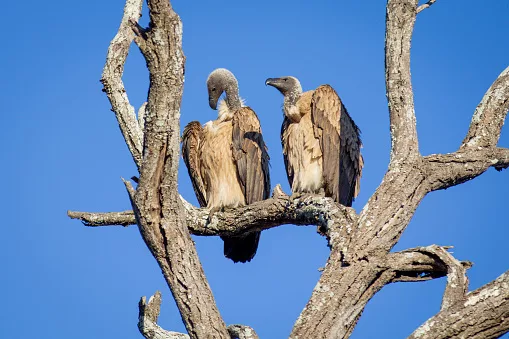
Two wild African white-backed vultures perch on a dead tree branch against a blue sky in Kruger National Park/By: Rebecca Harding/Getty Images
These highly adapted scavengers can soar for hours without much effort, digest carrion that would be dangerous to many other animals and spot food from remarkable distances. Some are devoted parents, some form long-term partnerships, and at least one species has developed an unusual talent for using tools.
Yet these fascinating birds are also among the world’s most threatened bird groups.
On International Vulture Awareness Day, here are eight things that might change how you see these often misunderstood birds. The annual awareness day takes place on the first Saturday of September.
1. They are masters of the skies
One of the most impressive things about a vulture is the way it flies.
Rather than constantly flapping their enormous wings, many vultures make use of rising columns of warm air called thermals. They circle within these invisible currents, gaining altitude and travelling long distances while conserving precious energy.
This is particularly useful for a scavenger that needs to cover huge areas in search of a carcass.
Some vultures are also among the largest flying birds on Earth. The Andean condor, for example, can have a wingspan of around 3.2 metres and weigh up to 15kg.
For vultures, soaring isn’t simply impressive to watch – it is an essential part of how they survive.
2. Their stomach acid is incredibly powerful
Eating decomposing animals comes with obvious risks, including exposure to bacteria and other pathogens that could make many animals seriously ill.
Vultures have evolved an extraordinary solution: extremely powerful stomach acid.
Their stomach acid can reach a pH of around 1.5, allowing them to digest carrion and helping them cope with potentially harmful microorganisms found in dead animals.
This adaptation is one reason vultures are so effective at their ecological role. While other scavengers may leave parts of a carcass behind, vultures can consume large quantities of dead animal tissue relatively quickly.
Their digestive systems essentially allow them to eat a meal that would be hazardous for many other species.
3. Their eyesight is better than you might think
Forget the image of a vulture blindly waiting around for its next meal.
Many Old World vultures have exceptionally sharp eyesight and can scan enormous areas while soaring high above the ground, looking for signs of a carcass.
Their ability to spot food from the air is a major advantage in open landscapes, where a single carcass can be difficult to locate from ground level.
Not all vultures rely on sight in the same way. Some New World vultures, including turkey vultures, have an excellent sense of smell and can detect carrion from considerable distances.
That means different vultures have evolved different sensory strategies to solve the same problem: finding dinner in a very big landscape.
4. They can be surprisingly devoted parents
The word “vulture” doesn’t exactly conjure up images of devoted motherhood and fatherhood, but these birds can be remarkably attentive parents.
Vultures typically form monogamous pairs and choose secluded locations such as cliffs, caves and tall trees for nesting. Both parents generally take turns incubating their eggs and helping to raise their chicks.
Their relatively slow breeding rate also makes every chick important.
For species already under pressure, losing an adult bird can have consequences beyond that individual’s death. A bird that might otherwise have bred for years has been removed from the population, while producing a replacement generation can take considerable time.
ALSO READ:
5. They are more social than their reputation suggests
Vultures aren’t necessarily the solitary creatures their sinister reputation might suggest.
Many species are highly social, gathering around food and using communal roosting sites. Their feeding behaviour can also involve large numbers of birds arriving at a carcass, sometimes creating a spectacular – if slightly chaotic – gathering.
They also communicate through body language, visual displays and vocalisations.
Their social lives extend to their relationships with mates, too. Vulture species commonly form long-term pairs, with some returning to the same nesting areas year after year.
So while a group of vultures gathered around a carcass might look rather ominous, it is actually an example of an efficient social feeding strategy.
6. They are nature’s clean-up crew
This may be the most important thing to know about vultures.
Dead animals are an unavoidable part of every ecosystem. If carcasses were simply left to decompose wherever they fell, they could become breeding grounds for pathogens and attract other scavengers.
Vultures help process these remains quickly, recycling nutrients and helping to keep ecosystems functioning.
Their powerful digestive systems are particularly valuable because they can consume carrion that contains microorganisms potentially dangerous to other animals. International Vulture Awareness Day describes them as nature’s “clean-up crew”, highlighting their role in removing dead animal remains and supporting healthy ecosystems.
In other words, vultures perform a job that would be extremely difficult for humans to replicate.
7. One species knows how to use tools
The Egyptian vulture has a party trick that sounds more like something you’d expect from a clever primate than a bird.
It can use stones as tools to break open large eggs, including ostrich eggs.
The bird picks up a suitable stone in its bill and repeatedly throws or strikes the egg until the shell cracks, allowing it to access the contents inside. The behaviour is one of the best-known examples of tool use among birds.
Egyptian vultures are fascinating for another reason, too. Some populations undertake enormous migrations, with birds travelling thousands of kilometres between breeding and wintering grounds. BirdLife International notes that some can travel up to 640km in a day during migration.
So the next time you see a vulture sitting quietly on a branch, don’t assume nothing is going on.
8. They are facing a serious conservation crisis
For all their remarkable adaptations, vultures are in trouble.
International Vulture Awareness Day estimates that around 70% of vulture species are threatened, making vultures one of the most threatened groups of birds. Major threats include poisoning, illegal killing, habitat loss, electrocution and collisions with power infrastructure.
South Africa is particularly important for vulture conservation, with several species facing serious threats.
The Cape vulture, for example, is currently assessed as Vulnerable. BirdLife South Africa identifies threats including poisoning, collisions with powerlines and wind turbines, electrocution, loss of foraging habitat and unsustainable harvesting. More than 1,900 individual Cape vultures have been recorded as having collided with or been electrocuted by electrical infrastructure since 1996, although not every incident is fatal.
Other South African vultures face even more severe pressures. BirdLife South Africa’s current Red List information places species including the white-backed, lappet-faced and white-headed vultures among those facing very high levels of extinction risk.
Poisoning is particularly devastating because vultures often feed communally. A single poisoned carcass can therefore kill numerous birds.
BirdLife South Africa has also documented lead poisoning in South African vulture populations, including links between lead fragments in shot animal carcasses and poisoning.
Why vultures deserve a second look
Vultures aren’t glamorous in the way that big cats, elephants or wild dogs are. They don’t have the same reputation as powerful predators, either.
But that is exactly what makes them so fascinating.
They are expert soarers, highly specialised scavengers, devoted parents and important members of healthy ecosystems. Their seemingly unpleasant diet has given them adaptations that few other animals possess, while their disappearance could have consequences far beyond the loss of a single bird species.
This International Vulture Awareness Day, the next time you spot a vulture circling above the landscape, look up for a little longer.
You might just be watching one of nature’s most underrated specialists at work.
Follow us on social media for more travel news, inspiration, and guides. You can also tag us to be featured.
Instagram | Facebook | Twitter
ALSO READ:
6 unusual antelope to look out for on your next South Africa safari