


South Africa has long been at the centre of the global fight to protect rhinos. But conservation is no longer only about protecting the animals already living in reserves.
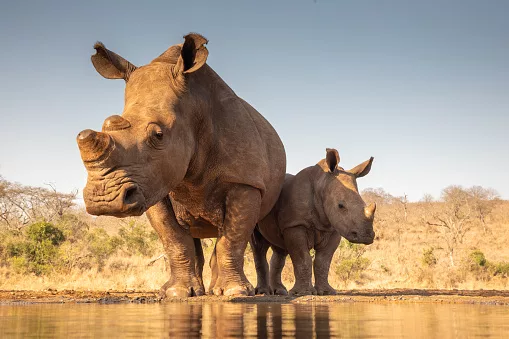
A mother and baby rhino approach a pond for drinking/By: PeterVanDam/iStock
Across the country, conservationists are moving rhinos into new habitats, strengthening existing populations, improving genetic diversity and creating safer landscapes where populations can grow. Some of these animals are eventually being moved beyond South Africa’s borders to help restore rhinos in countries where they have disappeared.
The approach is particularly important as South Africa continues to face pressure from poaching. A total of 352 rhinos were illegally killed in the country in 2025, although this was 16% fewer than in 2024. The decline is encouraging, but conservationists are looking at longer-term ways to make rhino populations more resilient.
As South Africa marks World Rhino Day on 22 September, these five places show how conservationists are looking beyond protecting today’s rhinos to creating new populations and securing a future for the species.
1. Hluhluwe-iMfolozi Park, KwaZulu-Natal
The place that helped save the southern white rhino
Few places have played such an important role in rhino conservation as Hluhluwe-iMfolozi Park.
In the late 19th century, southern white rhinos were thought to be close to extinction until a small population was discovered in what is now the iMfolozi section of the park. Their protection eventually led to Operation Rhino, the pioneering conservation programme that began moving white rhinos to other areas to establish new populations.
The results were extraordinary. Descendants of those rhinos went on to establish populations across South Africa and other African countries, making the park the source of one of the greatest wildlife conservation recoveries in history.
Today, Hluhluwe-iMfolozi is still contributing to rhino conservation while protecting its own populations.
Protecting the next generation
The park is home to both black and white rhinos, with black rhinos receiving particularly intensive monitoring. Conservation teams use foot patrols, aerial surveys and strategically placed camera traps to identify individual animals, monitor their health and understand population changes.
The information is important because individual black rhinos can be tracked throughout their lives, helping conservationists understand breeding success, population structure and where intervention may be needed.
The park’s success with black rhinos also means that surplus animals can be moved to other suitable areas, expanding the amount of habitat available to the Critically Endangered species.
Hluhluwe-iMfolozi therefore represents more than a historic conservation success. It remains part of the process of creating new rhino populations for the future.
2. Greater Kruger buffer reserves, Mpumalanga and Limpopo
View this post on Instagram
Bringing rhinos back into secure landscapes
Around the edges of Kruger National Park, a network of private and other conservation areas is becoming an important part of South Africa’s rhino future.
Through African Parks’ Rhino Rewild initiative, southern white rhinos rescued from a former captive-breeding operation are being moved into carefully selected protected areas. The destinations are assessed for habitat, security, management capacity and their ability to support viable populations.
The Greater Kruger Environmental Protection Foundation’s member reserves have already received substantial numbers of these animals.
In 2024, 120 southern white rhinos were moved into the Greater Kruger landscape. A further 160 were translocated in 2025, with the animals being placed under veterinary supervision and dehorned to reduce their vulnerability to poaching.
ALSO READ:
Small, strange and surprisingly important: Why we need aardwolves
Building a bigger safety net
The idea is not simply to put more rhinos into the bush. By strengthening populations across multiple protected areas, conservationists can spread risk and create additional populations outside the country’s biggest national park.
It is part of a much larger initiative. African Parks took responsibility for around 2,000 captive-bred southern white rhinos in 2023 with the aim of rewilding them into secure protected areas across Africa over a decade.
The Greater Kruger transfers are therefore one part of an ambitious attempt to turn animals that were once dependent on intensive management into wild rhinos contributing to functioning ecosystems.
3. Munywana Conservancy, KwaZulu-Natal
View this post on Instagram
Where community land is helping build a new rhino future
Munywana Conservancy offers a particularly interesting example because its conservation story is closely connected to land restitution and community ownership.
The 29,866-hectare conservancy includes land belonging to the Makhasa and Mnqobokazi communities, alongside private conservation partners including &Beyond Phinda and ZUKA Private Game Reserves. The communities chose to keep their restored land under conservation.
In May 2024, Munywana became the first destination in African Parks’ Rhino Rewild initiative, receiving 40 southern white rhinos.
The animals were moved there to strengthen the existing population, improve genetic diversity and create the possibility of future translocations. Conservation also supports tourism, which is an important part of the local economy.
From local conservation to continental rewilding
Munywana’s role has since grown beyond simply receiving rhinos.
The conservancy has acted as a staging and adaptation site for animals destined for other parts of Africa. Rhinos have spent time there becoming accustomed to natural conditions before undertaking major journeys to new habitats.
In 2025, 70 southern white rhinos that had spent time at Munywana were moved to Akagera National Park in Rwanda. Other rhinos from the conservancy have also contributed to the restoration of white rhinos in Garamba National Park in the Democratic Republic of Congo.
That makes Munywana an unusual example of conservation in action: community and private land in KwaZulu-Natal is helping support rhino restoration thousands of kilometres away.
4. Ithala Game Reserve, KwaZulu-Natal
Helping black rhinos return to places where they disappeared
The future of rhino conservation is not only about white rhinos.
Black rhinos remain much rarer, and creating additional populations is an important part of reducing the species’ vulnerability. Ithala Game Reserve in KwaZulu-Natal has become part of this effort through the Black Rhino Range Expansion Project.
The principle is straightforward: establish viable black rhino populations in suitable habitats beyond their existing strongholds.
One recent example demonstrates why this work matters beyond South Africa’s borders.
In June 2025, 10 critically endangered black rhinos were moved from South Africa to Zinave National Park in Mozambique. The animals were sourced from Ithala Game Reserve and Ezemvelo KZN Wildlife’s Black Rhino Range Expansion Project before being transferred to Hluhluwe-iMfolozi Park for preparation for their journey.
Creating a new population in Mozambique
The move was part of a longer project to restore black rhinos to Zinave, where they had disappeared decades earlier.
The 10 animals brought the total number of rhinos translocated to Zinave to 47. Conservationists hope the growing population will eventually become a viable breeding population, with genetic diversity strengthened by introducing animals from different sources.
It is a useful reminder that South Africa’s role in rhino conservation extends beyond its own borders.
Where successful populations can safely spare animals for carefully planned translocations, those rhinos can become the foundation for new populations elsewhere in Africa.
5. Greater Makalali Private Game Reserve, Limpopo
Creating space for black rhinos to recover
Greater Makalali offers another example of how private conservation areas can contribute to the future of rhinos.
The reserve actively participates in the WWF-led Black Rhino Range Expansion Project, supporting rhino relocations as well as field ranger and working-dog teams dedicated to protecting the animals.
The approach combines habitat, protection and biological management rather than relying on a single intervention.
Growing populations in safer landscapes
Greater Makalali’s conservation model demonstrates the role private reserves can play in providing additional habitat for threatened species.
Its conservation work has included the reintroduction of black rhinos, alongside continued protection of white rhinos and other threatened wildlife. The reserve’s security programme includes dedicated field rangers and K9 units.
For black rhinos in particular, every suitable and well-protected landscape matters. Expanding their range can help create additional populations and reduce the risks associated with concentrating too many animals in a small number of areas.
A future built on more than protection
South Africa’s rhino conservation story began with a small population of white rhinos in what is now Hluhluwe-iMfolozi Park. More than a century later, descendants of those animals are helping conservationists establish populations across the continent.
Rhinos are being moved between reserves to strengthen genetic diversity. Captive-bred animals are being returned to the wild. Community-owned land is becoming part of large-scale conservation initiatives, while South African black rhinos are helping rebuild populations in neighbouring countries.
African Parks reported that more than 300 rhinos had been translocated through its Rhino Rewild initiative by 2025, with 33 calves already born in the wild.
These projects do not make the threats disappear. Poaching remains a major challenge, and moving a rhino is only worthwhile when there is suitable habitat, strong protection and long-term management at its destination.
Follow us on social media for more travel news, inspiration, and guides. You can also tag us to be featured.
Instagram | Facebook | Twitter | Spotify
ALSO READ:
Hogsback after winter: Following the Amathole Mountains into spring