
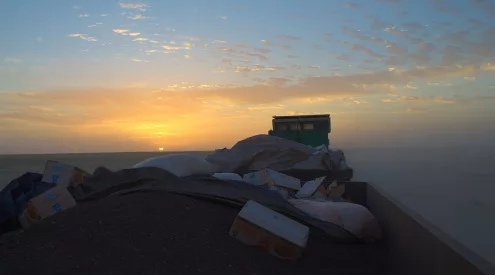


On Namibia’s northwestern frontier, the Atlantic crashes against a coastline so raw and remote that sailors once called it The Land God Made in Anger.

Skeleton Coast/Domenico Convertini from Zurich, Schweiz/Wikimedia Commons
To step onto the Skeleton Coast is to enter a wilderness that feels alive: dunes that shift overnight, fog that rolls off the sea like smoke, and the haunting skeletons of shipwrecks lying half-buried in sand.
For the intrepid traveller, this is safari reimagined. Here, elephants wander dune valleys, lions patrol dry riverbeds, and the only footprints in the sand might be your own.
A graveyard of ships

Shipwreck at Skeleton Coast/Domenico Convertini from Zurich, Schweiz/Wikimedia Commons
The Skeleton Coast stretches more than 500 kilometres from Swakopmund to Angola. For centuries, sailors feared its reputation. Strong Benguela currents and fog rendered navigation treacherous, and wrecked ships rarely meant rescue – their crews faced an unforgiving desert instead.
Today, many of those ships remain as eerie monuments. The Eduard Bohlen, stranded in 1909, lies several hundred metres inland, slowly engulfed by dunes. The Dunedin Star, whose wreck in 1942 led to a dramatic rescue operation, still rusts on the shore. Even newer wrecks – like the Zeila, visible near Henties Bay – add to the coastline’s surreal, cinematic atmosphere.
These skeletal hulls are more than relics: they are reminders of nature’s power, swallowed by a desert that never stops moving.
Wildlife in a sea of sand

Aerial photo of a seal colony at Namibia’s Skeleton Coast/Anagoria/Wikimedia Commons
A safari here is unlike anywhere else in Africa. Instead of teeming savannahs, wildlife survives against impossible odds.
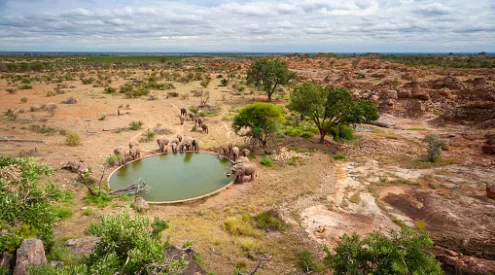
- Desert-adapted elephants trek vast distances in search of food, digging into dry riverbeds to reach hidden water.
- Lions have learned to hunt seals and seabirds along the coast – one of the only places in the world where lions meet the ocean.
- Brown hyenas scavenge shipwreck shores, nicknamed “strandwolves” for their beachcombing habits.
- The Skeleton Coast is home to some of the world’s largest Cape fur seal colonies, where tens of thousands gather on the rugged shoreline
- Oryx, springbok, and ostriches graze on scrubby vegetation in ephemeral riverbeds.
Every sighting feels hard-earned, a testament to resilience. Watching a herd of elephants emerge from swirling dunes feels almost mythical – as though the desert itself has conjured them.
Adventures for the intrepid
Visiting the Skeleton Coast is an adventure in itself. This is no casual detour: it demands effort, planning, and a taste for the unknown.
- Fly-in safaris deliver breathtaking aerial views of dunes rolling into the Atlantic, shipwrecks scattered like bones, and seal colonies stretching for kilometres.
- Guided 4×4 expeditions tackle soft sand, shifting tracks, and isolated campsites where the night sky burns with stars.
- Shipwreck-inspired lodges, such as Shipwreck Lodge near Möwe Bay, immerse travellers in design as striking as the landscape itself—cabins shaped like beached hulls, perched among the dunes.
- Hoanib Skeleton Coast Camp offers access to desert-adapted elephants and lions in the Hoanib River Valley, one of the richest wildlife corridors.
This is luxury wilderness: wild on the outside, comfortable on the inside.
The people of the coast

Himba village/Ana Raquel S. Hernandes from Sao Paulo, Brazil/Wikimedia Commons
Beyond its wildlife, the Skeleton Coast carries human stories. The Himba and Herero communities, with their deep desert knowledge, have long navigated this terrain, passing on oral histories of survival and adaptation. Fishing settlements dot the coastline, with Henties Bay a favourite among Namibians for its rich waters.
Some camps integrate cultural visits, offering travellers a glimpse into how people have thrived in an environment most would find uninhabitable. These encounters remind visitors that the Skeleton Coast isn’t just barren wilderness – it’s home, layered with history and resilience.
Why it belongs on your bucket list
For South Africans who have “done Kruger,” the Skeleton Coast offers the next frontier. This isn’t about ticking off the Big Five. It’s about stepping into an elemental world where sand, sea, and survival collide.
The drama is in the contrasts: fog-draped mornings giving way to searing afternoons; rusting iron against golden dunes; lions roaring within earshot of crashing waves. It’s a place that feels at once hostile and fragile, yet impossibly beautiful.
To experience it is to understand why remoteness itself can be the ultimate luxury.
Practical travel tips
- Best time to go: May to October, when days are cooler, skies are clearer, and wildlife is more visible. Summers can bring searing heat and heavy coastal fog.
- Getting there: Most travellers access the Skeleton Coast via Swakopmund, Damaraland, or fly-in charters from Windhoek. Self-driving is possible but requires experience with 4×4 off-roading in sand.
- Permits: Large parts of Skeleton Coast National Park are off-limits without permits or guided access. Tour operators typically arrange these.
- What to pack: Warm layers (foggy mornings are cold), a camera with good zoom, and an adventurous spirit. Connectivity is limited – prepare to unplug.
Follow us on social media for more travel news, inspiration, and guides. You can also tag us to be featured.
TikTok | Instagram | Facebook | Twitter
ALSO READ: Salt Pans and silence: Botswana’s Makgadikgadi magic


.jpg)

.jpg)